Aluminum vs. Ergonomic Crochet Hooks: Which Is Best for Speed, Comfort & Control?
If you have ever crocheted for a few hours and ended up with a tired thumb, stiff fingers, or a sore wrist, your crochet hook might be part of the problem. Traditional aluminum crochet hooks are simple, lightweight, durable, and often inexpensive. They have been a favorite for generations. Ergonomic crochet hooks, on the other hand, use wider, shaped, or cushioned handles designed to make the hook easier to hold during longer sessions. So which is actually better? The honest answer is: there isn't one perfect crochet hook for everyone. Your hand size, grip style, crochet speed, yarn, and the type of projects you make all matter. An ergonomic hook can make a huge difference for some crocheters, while another person may prefer the slim precision of a classic aluminum hook. Let's look at what really changes between the two.
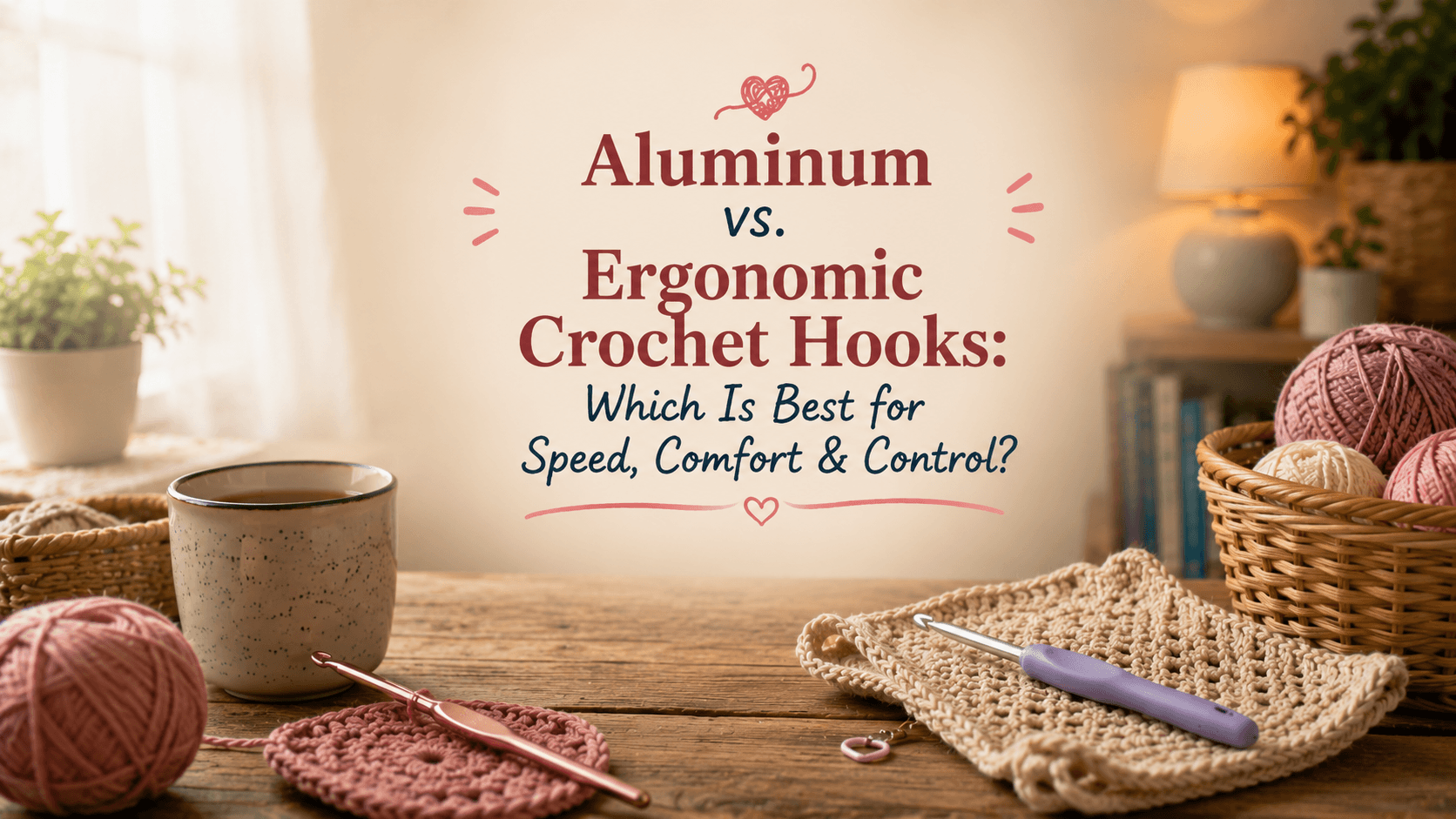
Aluminum vs. Ergonomic Crochet Hooks at a Glance
| Feature | Aluminum Crochet Hook | Ergonomic Crochet Hook |
|---|---|---|
| Handle | Slim metal shaft | Wider shaped or cushioned handle |
| Weight | Usually very light | Varies by design |
| Grip | Requires a smaller, more precise hold | Gives your hand a larger gripping surface |
| Long sessions | Can become tiring for some crocheters | Often more comfortable |
| Precision | Excellent for crocheters who like slim hooks | Depends on handle shape |
| Speed | Can feel very fast in experienced hands | Can improve consistency when your grip relaxes |
| Price | Usually inexpensive | Often more expensive |
| Best for | Budget sets, precision, experienced crocheters | Comfort, long sessions, frequent crocheting |
The important point is that ergonomic doesn't automatically mean better. It means the handle has been designed differently.
What Makes an Ergonomic Crochet Hook Different?
The hook head itself may still be made from aluminum. The biggest change is usually the part your hand holds.
A traditional aluminum hook has a narrow shaft with a thumb rest. Your fingers need to maintain a relatively small grip around that shaft. Ergonomic designs add a larger handle made from materials such as rubber, silicone, resin, or another molded material.
That extra surface area changes how you hold the hook.
Instead of pinching a thin metal shaft between your fingers, you can allow more of your hand to support the tool. This may make it easier to maintain a relaxed grip, particularly when you're working through a large blanket, sweater, or another repetitive project.
Recent crochet hook guides consistently emphasize handle width, grip shape, weight, and surface texture as important factors in comfort.
And there is an important catch: a bigger handle isn't automatically more comfortable. If the handle is too bulky for your hand, it can actually make precise stitches feel awkward.
Are Ergonomic Crochet Hooks Better for Hand Fatigue?
This is probably the biggest reason crocheters start looking into ergonomic hooks.
If you find yourself squeezing a slim aluminum hook tightly to keep it under control, a wider handle may allow you to loosen your grip. Spreading the contact area across more of your fingers can make repetitive crocheting feel more comfortable.
That doesn't mean an ergonomic hook will eliminate hand or wrist problems. Your posture, yarn tension, crochet technique, breaks, and total time spent crocheting matter too.
But if your main complaint is hand fatigue while crocheting, changing the handle is a sensible thing to experiment with before replacing your entire crochet setup.
A simple test
Take your usual aluminum hook and make a small swatch.
Pay attention to how tightly you're holding it.
Then try a wider ergonomic hook in the same size and work another swatch.
Don't focus on speed. Instead ask:
- Does my thumb feel more relaxed?
- Am I squeezing the hook less?
- Does the hook stay stable in my hand?
- Can I maintain the same tension?
- Does my wrist feel more relaxed?
- Can I crochet for longer without constantly readjusting my grip?
Those answers tell you more than a product description ever will.
Which Hook Is Faster?
This is where crochet hook comparisons often become misleading.
An ergonomic hook isn't automatically faster than an aluminum hook.
In fact, many experienced crocheters love traditional aluminum hooks precisely because they're light, slim, and easy to manipulate. A crocheter who has spent years using a particular aluminum hook may move it extremely quickly.
For another crocheter, however, an ergonomic handle can improve speed indirectly.
If your fingers are constantly slipping, squeezing, or readjusting a thin hook, your rhythm gets interrupted. A comfortable handle can make it easier to maintain a consistent motion.
So when it comes to crochet hook speed, comfort and control may matter more than the material itself.
Think of it this way:
The fastest crochet hook is usually the one you can control comfortably without constantly thinking about your grip.
When Aluminum Crochet Hooks Make More Sense
Don't dismiss traditional hooks just because ergonomic designs are popular.
Classic aluminum crochet hooks have some excellent advantages.
They're lightweight, straightforward, durable, and generally affordable. If you're building a large collection of crochet hook sizes, an aluminum set can also be much easier on your budget.
Their slim shape can be particularly appealing when you're working with fine yarn, thread, lace, or small stitches where you want precise control.
They're also a great choice if you naturally crochet with a relaxed grip and don't experience discomfort during longer projects.
For some crocheters, there is simply nothing wrong with a basic metal hook.
When Ergonomic Crochet Hooks Are Worth Trying
An ergonomic hook becomes much more interesting if you regularly crochet for long periods or find yourself gripping your hook tightly.
They're especially worth testing if:
- Your fingers become tired during long crochet sessions
- You frequently squeeze a slim hook tightly
- Your hook tends to roll in your hand
- You prefer a knife grip or pen grip and want more support
- You work on large repetitive projects
- You crochet several hours a week
- You want a softer, more substantial handle
- You simply find traditional hooks uncomfortable
Comfort is highly individual, though. Some crocheters prefer narrow handles, while others immediately feel more relaxed with a thick grip. Current crochet hook guides also recommend trying a single hook before investing in a complete set.
Grip Shape Matters More Than You Might Expect
Two ergonomic hooks can feel completely different even if they're the same size.
Some handles are rounded.
Others have a flattened thumb rest. Some are tapered, while others have a much thicker barrel designed to fill the palm.
Your crochet hook grip plays a major role here.
If you use a pencil-style grip, you may prefer a hook that gives your thumb and index finger a defined resting position.
If you use a knife-style grip, a different handle shape may feel more natural.
There is no universal ergonomic shape because hands aren't universal either.
A handle that feels perfect to someone with large hands may feel oversized to someone with smaller hands.
Don't Forget the Hook Head
When comparing aluminum vs. ergonomic crochet hooks, it's easy to focus entirely on the handle.
But the hook head matters too.
The head needs to move smoothly through your stitches and catch the yarn without unnecessary snagging. Different crochet hooks also use different head geometries, including tapered and inline-style designs.
Some crocheters prefer a tapered head because it slides easily into stitches. Others like the more defined shape of an inline hook because it gives them a particular level of control.
Neither design is objectively better for everyone. Your yarn, tension, stitch style, and personal preference all influence what feels best.
What About Weight and Balance?
A common assumption is that a heavier crochet hook must be better because it feels more substantial.
Not necessarily.
When you're crocheting for a long time, every little movement is repeated hundreds or thousands of times. A hook that feels comfortable for five minutes may feel very different after two hours.
A lightweight aluminum shaft combined with a comfortable ergonomic handle can be a useful combination because the grip feels substantial without making the entire tool unnecessarily heavy.
On the other hand, some crocheters genuinely prefer a heavier, balanced hook because they like the way it rests in their hand.
The goal isn't to find the lightest or heaviest hook.
It's to find the hook that feels balanced in your hand without making you squeeze it.
What Should Beginners Buy?
If you're completely new to crochet, you don't need to spend a fortune on hooks.
A basic aluminum hook is perfectly capable of teaching you how to crochet. You can learn chains, single crochet, half double crochet, double crochet, increases, decreases, and many beginner projects with a traditional hook.
But if you already know that comfort is important to you, starting with an ergonomic crochet hook is also completely reasonable.
The best beginner crochet hook is ultimately one that:
- Matches your yarn and pattern.
- Feels comfortable in your hand.
- Lets you control your stitches.
- Doesn't force you to squeeze tightly.
- Fits your budget.
You don't need a $20+ hook to become a good crocheter.
Skill comes from practice—not from the price of your hook.
A Cheap Way to Test Ergonomic Handles
Not ready to buy an entire ergonomic crochet hook set?
Try modifying one of your existing hooks first.
A removable foam or silicone grip can increase the diameter of a slim aluminum hook and give you an idea of whether a larger handle feels better in your hand.
It's not exactly the same as a purpose-built ergonomic hook, but it's a useful experiment before spending money on a complete collection.
If you immediately notice that your fingers relax and your grip becomes lighter, that's a good indication that ergonomic handles may suit your crochet style.
Which Is Best for Long Crochet Sessions?
For long crochet sessions, I'd give the advantage to ergonomic hooks if you tend to experience fatigue from gripping a thin handle.
A wider, comfortable grip can make it easier to maintain a relaxed hold, which is particularly useful when you're working through hundreds of repetitive stitches.
But if you already crochet comfortably with aluminum hooks, there's no reason to switch simply because ergonomic hooks are marketed as more comfortable.
Your own hands are the best test.
Aluminum or Ergonomic: Which One Should You Choose?
Here's the simplest way to decide:
Choose aluminum if you want:
- A lightweight and inexpensive hook
- A slim handle
- Maximum familiarity and simplicity
- Precise manipulation
- A large collection without spending much
- A traditional crochet experience
Choose ergonomic if you want:
- A wider gripping surface
- More handle cushioning
- A potentially more relaxed grip
- Better comfort during long sessions
- A handle designed around hand support
- An alternative to constantly squeezing a thin hook
And if you're still undecided, don't choose a whole set.
Buy one hook in the size you use most.
Crochet with it for several sessions. Try a blanket, a small amigurumi project, or whatever you normally make. If your hand naturally relaxes and the hook feels easier to control, then you have your answer.
The Best Crochet Hook Is the One You Forget You're Holding
There is no winner in the aluminum vs. ergonomic crochet hook debate for everyone.
A basic aluminum hook can be incredibly fast and precise in the right hands. An ergonomic hook can make a long crochet session noticeably more comfortable for someone who dislikes a thin grip.
The real goal isn't finding the most expensive hook, the most popular hook, or even the hook that someone else calls the "best."
It's finding one that lets you hold the hook lightly, maintain consistent tension, and crochet without constantly thinking about your hands.
Once the tool disappears into the background, you can concentrate on the part that actually matters: enjoying your project.
Frequently Asked Questions
Are ergonomic crochet hooks better than aluminum hooks?
Not universally. Ergonomic hooks are often preferred by crocheters who want a wider or cushioned grip, while traditional aluminum hooks remain popular for their lightweight, slim design and affordability. Comfort depends heavily on your hand and crochet grip.
Are ergonomic crochet hooks worth it?
They can be worth it if you crochet frequently, work on large projects, or find slim hooks uncomfortable. If traditional aluminum hooks already feel comfortable, upgrading may not provide much benefit.
What are the best crochet hooks for hand fatigue?
Look for a hook with a comfortable, appropriately sized handle, a smooth hook head, and a weight that doesn't make your hand work harder. A wider grip may help you avoid squeezing a thin handle too tightly.
Do ergonomic crochet hooks make you crochet faster?
Not automatically. Speed comes from technique and practice, but a comfortable hook can help you maintain a consistent rhythm if your traditional hook causes slipping, tension, or frequent grip adjustments.
Are aluminum crochet hooks good for beginners?
Absolutely. They're inexpensive, durable, lightweight, and available in many sizes. They're an excellent way to learn crochet without making a large investment.
Should I buy a whole ergonomic crochet hook set?
If you already know you like ergonomic handles, a set can be convenient. If you've never used one before, try a single hook in your most-used size first. Your preferred handle shape can be surprisingly personal.
Can an ergonomic crochet hook help with hand discomfort?
A wider or cushioned handle may make gripping more comfortable for some crocheters by allowing a less concentrated grip. However, persistent pain, numbness, or weakness shouldn't simply be crocheted through; consider taking breaks and getting appropriate professional advice.
Final Takeaway
Aluminum crochet hooks win on simplicity, price, and lightweight precision. Ergonomic crochet hooks win when handle comfort and long-session control become the priority.
If your current hook feels good, keep using it.
If you finish every crochet session shaking out your fingers because you've been gripping a skinny metal hook for hours, that's when it's worth experimenting with an ergonomic design.
Sometimes the best crochet upgrade isn't a new yarn or a bigger pattern.
It's simply a hook that feels better in your hand.
Ready to put your favorite hook to work? Explore AlbaCrochet digital PDF patterns for amigurumi, blankets, accessories, and more—with clear instructions designed to make every stitch easier to follow.
Ready to make something?
Put your new skills to use with our free pattern collection.