How Long Does It Take to Learn Crochet? A Realistic Timeline for Beginners
If you're wondering how long it takes to learn crochet, the short answer is: you can learn the basic movements in a few hours, but becoming comfortable with crochet usually takes a few weeks of practice. There isn't one exact timeline for everyone. Some beginners make their first chain and single crochet on day one, while others need several practice sessions before their hands feel comfortable. More advanced skills—such as reading patterns, shaping garments, or designing your own projects—can take months or longer. The good news is that you don't need to master everything before making something you love.
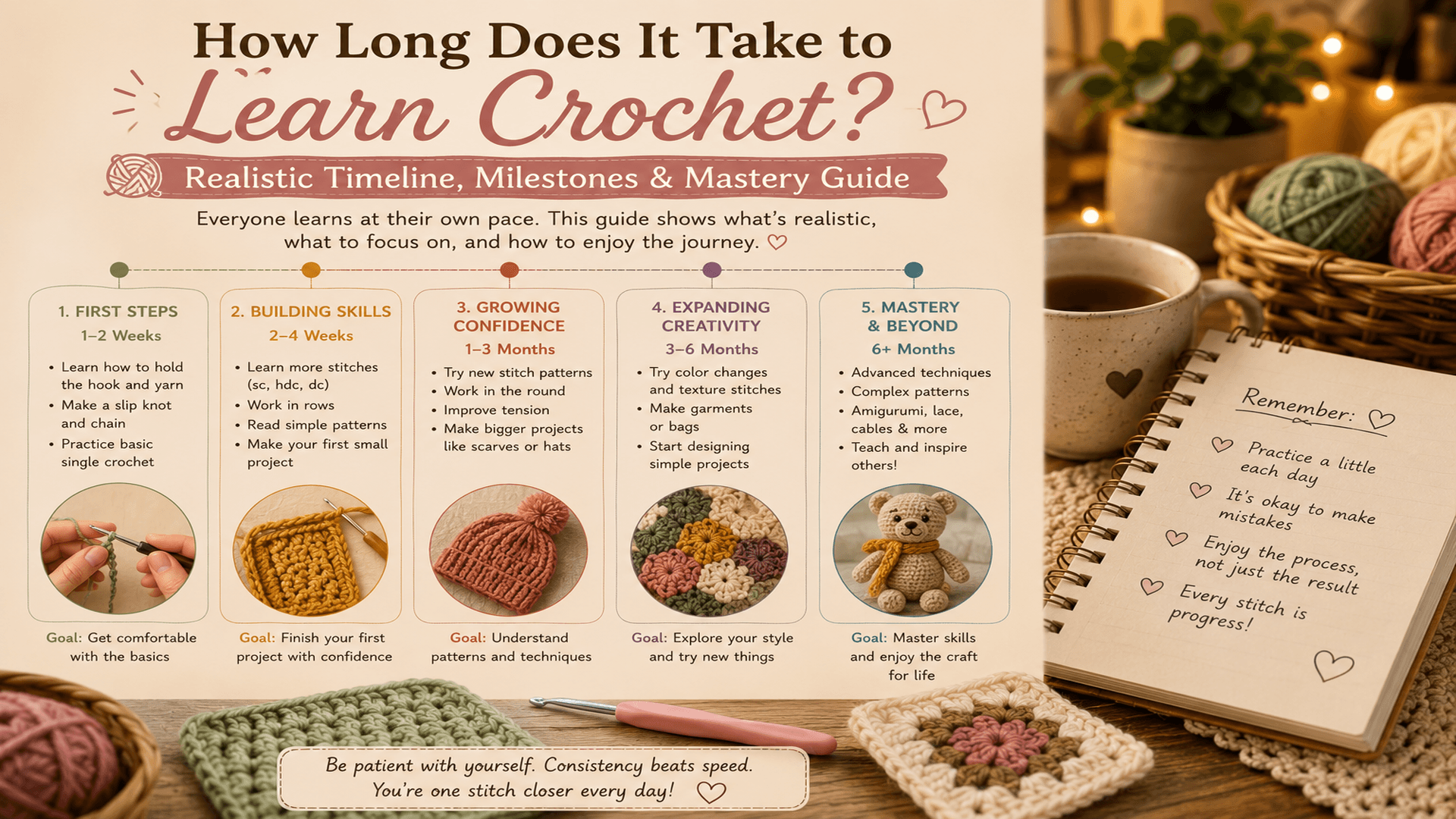
How Long Does It Take to Learn Crochet?
For many beginners, a realistic crochet learning timeline looks something like this:
- A few hours to a few days: Learn how to hold the hook and yarn, make a slip knot, chain, and practice a basic stitch.
- 1 to 2 weeks: Become more comfortable with basic stitches and complete a small beginner project.
- 1 month: Start reading simple crochet patterns and learn skills such as increasing, decreasing, working in rows, or working in the round.
- Several months: Become more confident with different stitch combinations, shaping, color changes, and more detailed projects.
- Ongoing: Advanced techniques, garment fitting, pattern modification, and crochet design continue to develop with experience.
Think of learning crochet less like reaching one finish line and more like gradually adding new skills to your toolbox.
Day 1: Learn the Basic Crochet Movements
Your first crochet session can feel awkward—and that's completely normal.
The first things to learn are:
- How to make a slip knot
- How to hold your crochet hook
- How to hold and control the yarn
- How to make a chain
- How to work a basic stitch, usually single crochet
Don't worry if your first chain is uneven or your stitches look nothing like the tutorial. Most beginners struggle with tension at first.
Instead of trying to make a perfect project immediately, spend some time making small practice swatches. Pull them apart, try again, and let your hands get used to the movements.
A helpful beginner tip
Choose one comfortable hook grip—either the pencil grip or knife grip—and stick with whichever feels more natural. There is no single "correct" way to hold a crochet hook.
Your First Week: Basic Stitches and Straight Rows
After a few practice sessions, you can begin learning the basic crochet stitches used in many beginner patterns.
These usually include:
- Chain stitch (ch)
- Single crochet (sc)
- Half double crochet (hdc)
- Double crochet (dc)
You don't need to learn all of them at once. Start with one stitch and practice working it across several rows.
During your first week, one of the biggest challenges is usually keeping your stitch count consistent. Beginners often accidentally skip the first or last stitch of a row, causing their project to get narrower.
A simple fix is to place stitch markers in the first and last stitch of each row.
Good first crochet projects
Once you can make reasonably consistent stitches, try something small and forgiving, such as:
- A washcloth
- A coaster
- A mug rug
- A simple scarf
- A basic granny square
These projects help you practice without committing to a huge blanket or complicated garment.
Weeks 2 to 4: Start Making Real Projects
This is often when crochet starts to feel much easier.
Your hands begin remembering the movements, so you don't have to think about every yarn over and pull-through. Your tension may still vary, but you will probably notice that your stitches are becoming more consistent.
At this stage, you can start learning:
- How to increase
- How to decrease
- How to join new yarn
- How to fasten off
- How to weave in ends
- How to work in the round
- How to read simple crochet abbreviations
Depending on your practice and the difficulty of the pattern, you may also be ready to try beginner hats, simple bags, granny square projects, or basic amigurumi.
After One Month: Can You Read Crochet Patterns?
Many beginners can start following simple written patterns within their first month, although pattern reading takes practice.
At first, a line like this can look confusing:
Ch 20, sc in 2nd ch from hook, sc across.
But once you understand the abbreviations and repeat the process a few times, patterns become much easier to follow.
A good way to learn is to keep a small crochet abbreviation guide nearby. You will quickly become familiar with common terms such as:
- ch – chain
- sc – single crochet
- hdc – half double crochet
- dc – double crochet
- st – stitch
- rep – repeat
- inc – increase
- dec – decrease
Just remember that crochet terminology can differ between US and UK patterns, so always check which terminology the pattern uses before starting.
How Long Does It Take to Get Good at Crochet?
This depends on what "good" means to you.
If your goal is to make scarves, blankets, granny squares, and simple amigurumi, you may feel confident after a few weeks or months of regular practice.
If you want to crochet fitted sweaters, modify patterns, create detailed lacework, or design your own patterns, expect the learning process to continue much longer.
The important thing is that you don't need advanced skills to create beautiful projects.
A beginner with good tension and patience can make an impressive blanket using only a few basic stitches.
A Realistic Crochet Learning Timeline
| Time Practicing | What You May Be Learning |
|---|---|
| First day | Slip knot, chains, basic hook and yarn control |
| First few days | Single crochet and simple rows |
| 1–2 weeks | Basic stitches, turning, counting stitches, small projects |
| 2–4 weeks | Increases, decreases, working in the round, simple patterns |
| 1–3 months | More complex patterns, color changes, shaping, textured stitches |
| 3–6+ months | More confidence with garments, advanced techniques, and pattern modifications |
These are general milestones, not deadlines. Someone who crochets for 15 minutes a few times a week will progress differently from someone practicing every day.
What Makes Learning Crochet Faster?
You don't need to crochet for hours every day. Consistent practice is usually more useful than overwhelming yourself with one huge session and then putting the project away for weeks.
Here are a few ways to make learning easier.
Start With the Right Yarn
Smooth, medium-weight yarn is usually easier for beginners than fuzzy, dark, or highly textured yarn.
When you're learning, being able to clearly see each stitch makes a big difference.
Use a Comfortable Hook Size
A medium-sized hook and yarn combination is generally easier to control than very tiny crochet hooks or extremely bulky yarn.
Always check the yarn label and pattern recommendations before choosing your hook size.
Make Small Practice Projects
A huge blanket can take months and may become frustrating if you're still learning basic skills.
Small projects give you more opportunities to practice starting, turning, fastening off, and finishing.
Don't Frog Every Imperfect Stitch
Your first projects do not need to be perfect.
If you notice a tiny tension difference that doesn't affect the shape or structure of your project, consider leaving it and continuing. Learning when a mistake actually needs fixing is part of becoming a more confident crocheter.
How Often Should You Practice Crochet?
There is no perfect number of minutes per day.
Even short practice sessions can help you become familiar with the movements. The key is to give yourself enough repetition to build confidence without turning crochet into a stressful chore.
You might try:
- 15–30 minutes a day, or
- A few longer sessions each week
Stop if your hands become uncomfortable or fatigued, and take breaks during longer sessions.
When Are You No Longer a Beginner Crocheter?
There is no official test that tells you when you've graduated from "beginner" to "intermediate."
A good sign is when you can:
- Understand a simple pattern without needing to search every abbreviation
- Keep track of your stitch count
- Recognize common mistakes
- Fix basic errors
- Choose an appropriate hook and yarn
- Learn a new stitch from written or visual instructions
At that point, you may still have plenty to learn—but you'll have the foundation needed to explore almost any type of crochet.
The Best Way to Learn Crochet
The fastest way to improve isn't necessarily to memorize dozens of stitches.
Start with the basics, make something small, and then choose your next project based on one new skill you want to learn.
For example:
First project: Practice single crochet
Next project: Learn double crochet
After that: Try increases and decreases
Then: Learn to work in the round
This approach keeps each project manageable while gradually expanding your skills.
Final Thoughts
So, how long does it take to learn crochet?
You can learn the basics surprisingly quickly, often within your first few practice sessions. Becoming comfortable with beginner projects may take a few weeks, while developing confidence with more advanced techniques can take months or years.
Don't judge your progress by how quickly someone else learned. Crochet is a practical skill, and every project teaches you something new.
The best thing you can do is pick up your hook, practice the basics, and make something—even if your first few rows are a little uneven.
Every experienced crocheter started with their first chain too.
Ready to make something?
Put your new skills to use with our free pattern collection.