How to Fix a Missed Crochet Stitch Several Rows Back: 4 Ways to Repair Crochet Without Starting Over
Found a skipped crochet stitch several rows below your hook? Don't panic. A missed stitch can make your crochet look uneven, create a small hole, or throw off your stitch count—but you don't always have to unravel the entire project. In this guide, you'll learn how to fix a missed crochet stitch, when it's better to frog back to the mistake, and how to repair a small gap with a crochet hook or tapestry needle when undoing isn't practical.
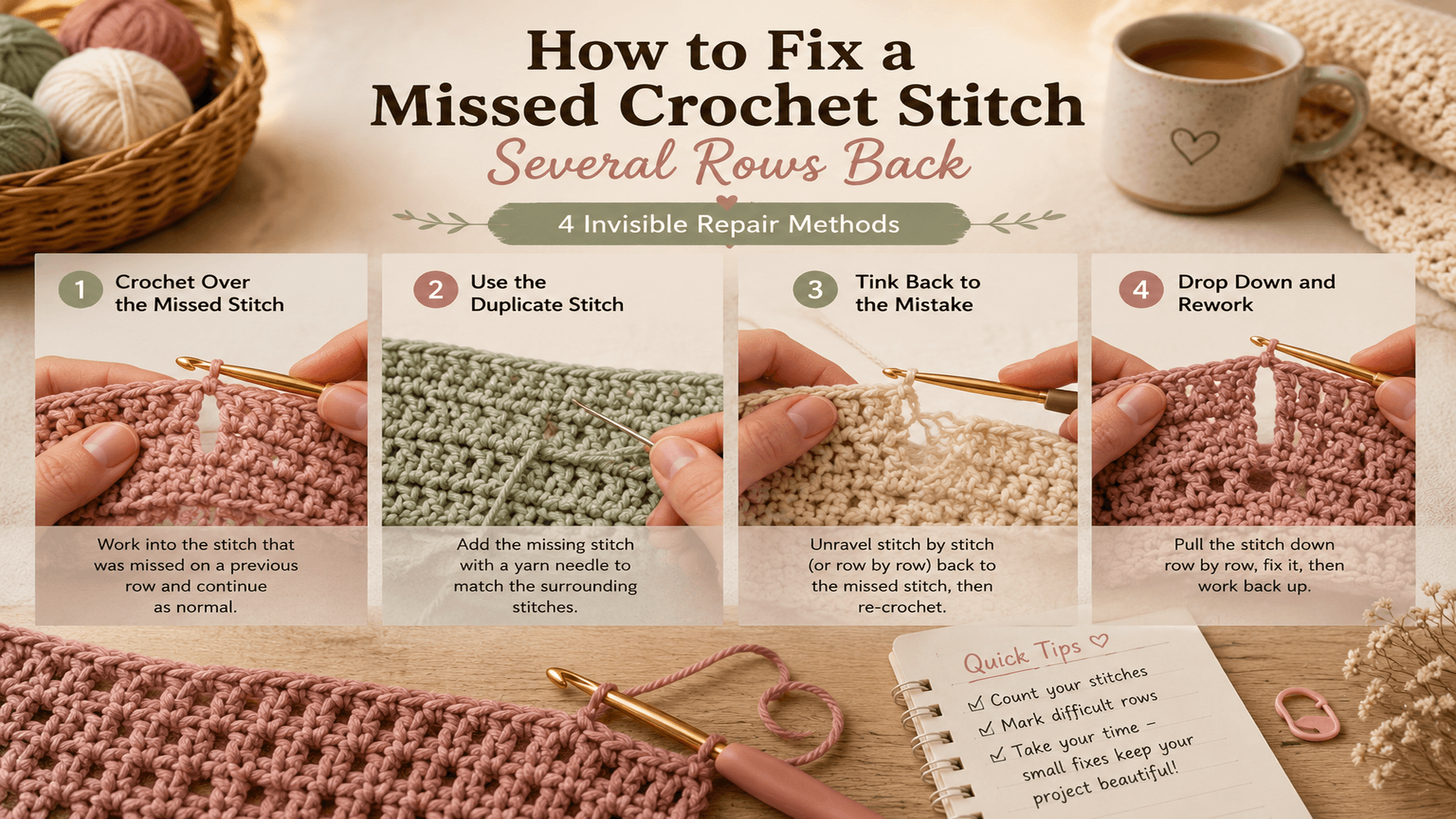
Quick Answer: Can You Fix a Missed Crochet Stitch Without Frogging?
Yes, sometimes.
If the missed stitch has already been buried under several rows, you have a few options. You can carefully frog back to the skipped stitch, compensate for the lost stitch if the project allows it, or use matching yarn and a tapestry needle to visually rebuild a missing stitch.
The right method depends on how many rows back the mistake is, where it occurs, the stitch pattern, and whether the missing stitch affects the shape of the project.
For blankets and simple scarves, a small correction may be easy to hide. For fitted garments, lace, amigurumi, or carefully shaped pieces, correcting the original mistake is usually the safest choice.
Why Does a Missed Crochet Stitch Cause Problems?
A skipped stitch doesn't always look dramatic at first.
You might notice that your project has:
One fewer stitch than the pattern calls for
A small hole in the fabric
An edge that starts pulling inward
A section that looks narrower than the rows below
A stitch pattern that no longer lines up
An increase or decrease that appears in the wrong place
This is why counting crochet stitches regularly is so useful. A single missing stitch can become much more noticeable as additional rows are worked above it. Current crochet troubleshooting guides consistently identify missed or added stitches and incorrect stitch counts as some of the most common crochet problems. (Joanna's Crochet)
Before reaching for your hook, flatten the project and inspect the fabric from both sides. Sometimes what looks like a missed stitch is simply a tension change or a stitch worked into an unusual loop.
4 Ways to Fix a Missed Crochet Stitch Several Rows Back
1. Frog Back to the Missed Stitch
If the missing stitch affects the shape or stitch count, frogging back is the most reliable fix.
Yes, it can be annoying to undo several rows—but you're correcting the actual problem rather than disguising it.
Place a stitch marker in the last correct stitch before the mistake. Then gently pull the working yarn to unravel the rows until you reach that point.
Don't rush this part. Stop before the mistake and undo the final stitches individually if necessary. This gives you much more control and prevents you from accidentally unraveling good work.
Once you've reached the missed stitch:
Insert your hook into the correct stitch.
Work the skipped stitch according to the pattern.
Recreate the stitches you previously removed.
Check your stitch count.
Continue with the next row.
For lace, fitted clothing, amigurumi, and projects with precise shaping, this is generally the method I'd recommend.
2. Add an Increase to Restore the Stitch Count
If you've discovered the mistake several rows later and the exact location isn't visually important, you may be able to correct the stitch count without unraveling.
For example, suppose your pattern requires 30 stitches but you accidentally have 29.
Instead of ripping everything back, you can work two stitches into one stitch at a suitable location on the current row. That gives you the missing stitch and brings the row back to 30 stitches.
This is a practical solution rather than a completely invisible repair. The fabric may have a tiny irregularity where the increase was added.
It's often acceptable for:
Blankets
Scarves
Dishcloths
Simple home décor
Loose-fitting projects
Avoid this approach when the missing stitch changes shaping, symmetry, lace placement, or garment sizing.
3. Rebuild the Missing Stitch With a Crochet Hook
For a small hole where the missing stitch is easy to identify, you can create a replacement stitch using matching yarn.
This technique is particularly useful when you don't want to disturb several completed rows.
Here's the basic idea:
Find the exact location where the stitch should have been.
Use a crochet hook close to the size used for the project.
Insert the hook through the base of the missing stitch.
Attach a short piece of matching yarn.
Pull the yarn through the fabric.
Recreate the approximate height of the missing stitch.
Secure the ends on the wrong side.
The replacement doesn't actually reconnect the original working row in the same way as a correctly crocheted stitch. Instead, you're reconstructing the appearance and structure of the missing area.
This makes it more suitable for small localized repairs than for correcting a major stitch-count error.
A similar repair method is recommended by Lantern Moon, which describes creating a replacement or “fake” stitch with a hook and matching yarn when a stitch has been missed. (Lantern Moon)
4. Use a Tapestry Needle for an Invisible-Looking Repair
If the mistake has left a visible hole but the surrounding fabric is already several rows deep, a tapestry needle and matching yarn can sometimes provide the cleanest cosmetic repair.
Thread a short length of the same yarn onto a blunt tapestry needle.
Working from the wrong side:
Bring the needle through the base of the gap.
Follow the direction of neighboring stitch posts.
Recreate the missing vertical section.
Form a small top loop that resembles the surrounding stitches.
Compare the tension with the stitches around it.
Weave both yarn tails securely into the back.
The key is matching the neighboring stitch anatomy, not simply filling the hole with random stitches.
Pulling the repair yarn too tightly can create a puckered spot that is actually more noticeable than the original mistake.
What If the Missed Stitch Is at the Edge?
Edge stitches deserve special attention.
A missed stitch at the beginning or end of a row can gradually make a rectangular project become narrower. If several rows have already been worked, you may notice that one side is slanting inward.
In this situation, simply adding an increase somewhere in the middle of the row may restore the stitch count but won't necessarily restore the correct edge shape.
For a blanket, scarf, or flat panel, fixing the original missed edge stitch is usually worth the extra frogging.
If you're working a garment or another fitted piece, definitely correct the original error rather than trying to compensate elsewhere.
Should You Frog or Repair the Mistake?
Here's an easy rule:
| Situation | Best choice |
|---|---|
| Mistake is only a few stitches back | Frog to it |
| Mistake changes the shape | Frog to it |
| Lace or complex stitch pattern | Frog to it |
| Amigurumi shaping is affected | Frog to it |
| Simple blanket with tiny error | Consider a correction |
| Small cosmetic hole | Needle repair |
| Stitch count is off but shape isn't affected | Consider an increase |
| Mistake is barely visible | You may be able to leave it |
There's no prize for frogging more than necessary. But there's also no benefit in hiding a structural mistake that will continue affecting the project.
A useful rule is: structural errors deserve correction; tiny cosmetic imperfections often don't. (DailyAtlas)
How to Prevent Missed Stitches in Crochet
The easiest crochet mistake to fix is the one you catch early.
Count at the end of every row
If your pattern says 25 stitches, make sure you actually have 25 before turning.
Mark the first and last stitch
A removable stitch marker makes edge stitches much easier to identify, especially when you're working into dense single crochet.
Count difficult sections separately
For long rows, place markers every 10–20 stitches. This makes it much easier to locate where your count went wrong. (Crochet Calc)
Pay special attention to the first and last stitch
These are some of the easiest stitches to accidentally skip, particularly when working around turning chains.
Stop when something looks wrong
If your crochet suddenly becomes narrower, wider, or develops an unexpected hole, don't continue for another five rows hoping it will correct itself.
It usually won't.
Frequently Asked Questions
Can you fix a skipped crochet stitch without unraveling?
Yes, depending on the project. A small missed stitch can sometimes be compensated for with an increase or repaired using matching yarn and a tapestry needle. However, if the missed stitch affects shaping or the overall stitch pattern, frogging back to the mistake is usually the most accurate solution. (CrochetTalk)
How do you fix a crochet mistake several rows back?
First identify exactly where the mistake occurred. If it affects the structure or stitch count, place a marker at the last correct row and carefully frog back to the error. For a small cosmetic hole, you may be able to rebuild the missing stitch with matching yarn instead.
Can I add a stitch to fix my crochet stitch count?
You can sometimes add an increase to restore a missing stitch, especially in forgiving projects such as blankets and scarves. However, this doesn't recreate the original stitch in its correct location, so it isn't ideal for precise shaping.
What is the easiest way to fix a missed stitch in crochet?
If you notice it immediately, undo the last few stitches and work the missed stitch correctly. The farther back you discover the mistake, the more useful it becomes to decide whether the error actually needs correcting or whether a localized repair will be sufficient.
Is it better to frog or hide a crochet mistake?
If the mistake changes the size, shape, stitch count, or pattern repeat, frog it. If it's a tiny cosmetic error that won't affect the finished piece, repairing or leaving it alone may save considerable time.
Final Thoughts
Finding a missed crochet stitch several rows back can feel like a disaster, but it doesn't automatically mean starting over.
Take a breath, locate the mistake, and decide whether you're dealing with a structural problem or a cosmetic one. Sometimes the best answer really is to frog back and redo the stitches. Other times, a carefully placed increase or a small needle repair can save hours of work.
The goal isn't to make every project absolutely perfect. It's to know which crochet mistakes matter, which ones can be repaired, and when it's safe to simply keep crocheting.
Ready to make fewer mistakes while following patterns? Explore AlbaCrochet digital PDF patterns with clear stitch counts, row-by-row instructions, helpful checkpoints, and beginner-friendly guidance designed to make every project easier to follow.
Ready to make something?
Put your new skills to use with our free pattern collection.