How to Read Crochet Abbreviations: US vs UK Terms and Pattern Symbols
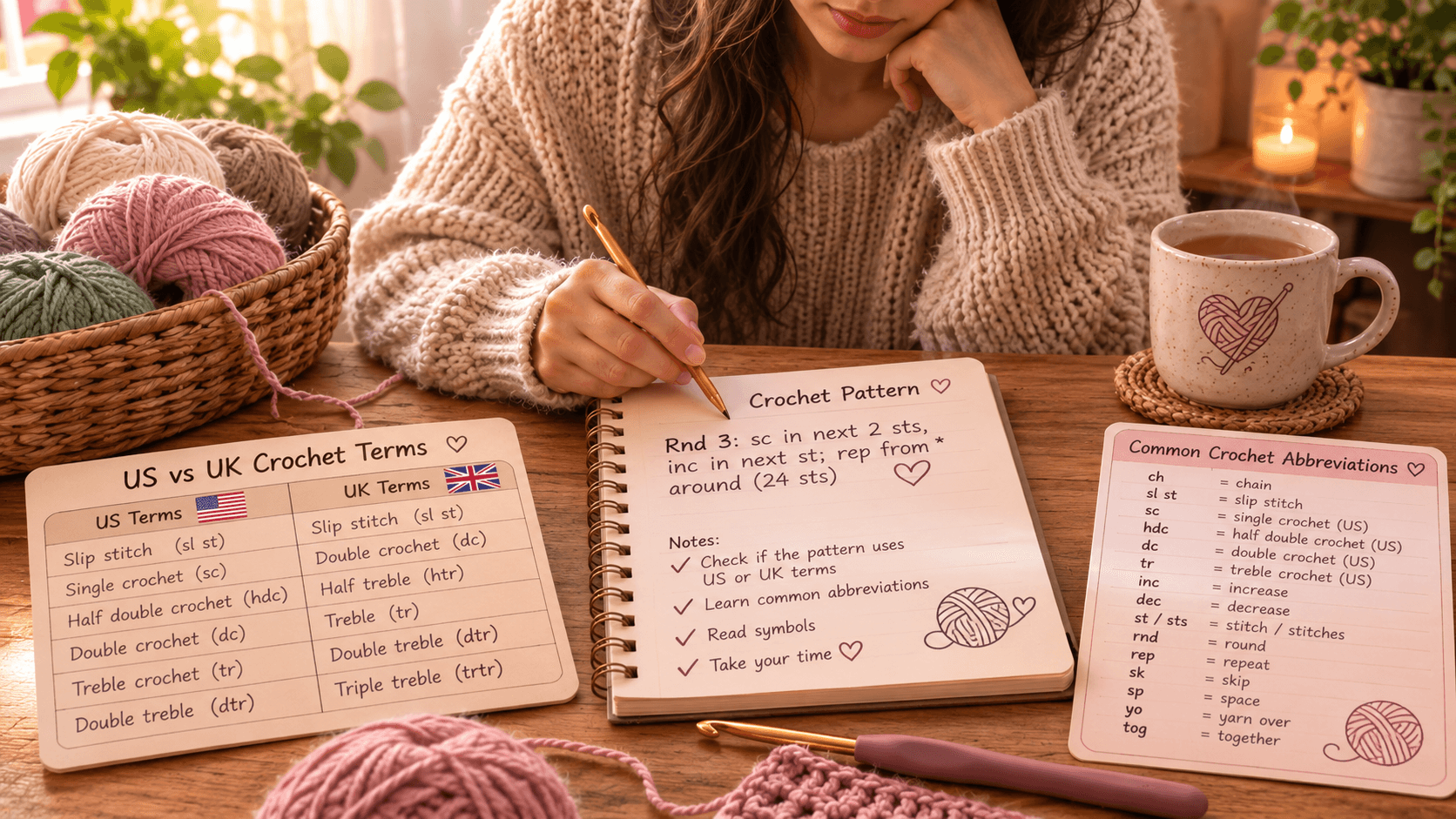
The first time you open a crochet pattern, it can feel like you're reading another language. You might see something like this: *Rnd 3: sc in next 2 sts, inc in next st; rep from * around (24 sts) If you're a beginner, that single line can look more confusing than the actual crocheting. The good news is that crochet abbreviations are simply shorthand. Once you understand the most common terms, symbols, and repeat instructions, patterns become much easier to follow. The most important thing to learn first is that crochet terminology can change depending on where the pattern was written. A US double crochet (dc) is not the same stitch as a UK double crochet (dc). Using the wrong terminology can completely change the size and appearance of your project. This guide explains how to read crochet abbreviations, understand US and UK terms, decode pattern symbols, and break down complicated-looking instructions step by step.
Before You Start: Check Whether the Pattern Uses US or UK Terms
This is one of the most important things to check before starting any crochet pattern.
The US and UK systems often use similar abbreviations, but they can refer to different stitches.
For example:
In US terms,
scmeans single crochet.In UK terms, that same stitch is called
dc, or double crochet.
The difference continues with taller stitches.
| US Term | US Abbreviation | UK Term |
|---|---|---|
| Slip stitch | sl st | Slip stitch |
| Single crochet | sc | Double crochet |
| Half double crochet | hdc | Half treble |
| Double crochet | dc | Treble |
| Treble crochet | tr | Double treble |
| Double treble | dtr | Triple treble |
The Craft Yarn Council's terminology comparison shows the same US/UK conversion and also notes differences such as US gauge versus UK tension.
How can you tell which terminology a pattern uses?
Many modern patterns clearly say:
US Terms
US Crochet Terms
UK Terms
British Terms
Look near the beginning of the pattern, usually around the materials list or abbreviation section.
If the pattern doesn't clearly say, look for clues.
If you see sc, it is using US terminology because UK terminology does not use sc as the name for the basic single-crochet-height stitch.
If you are unsure, don't start crocheting immediately. Look for the abbreviation key or compare the stitch instructions with a reliable terminology chart.
Getting this wrong can significantly change the height and gauge of your finished project.
The Most Common Crochet Abbreviations
You don't need to memorize every abbreviation before starting.
Learning the most common ones will allow you to understand a large number of beginner and intermediate patterns.
Basic stitch abbreviations
| Abbreviation | Meaning in US Terms |
|---|---|
| ch | chain |
| sl st | slip stitch |
| sc | single crochet |
| hdc | half double crochet |
| dc | double crochet |
| tr | treble crochet |
| dtr | double treble crochet |
These abbreviations are part of the standard US terminology listed by the Craft Yarn Council.
Example
Instead of writing:
Make one double crochet in each of the next five stitches.
A pattern may simply say:
dc in next 5 sts
Once you know that:
dc= double crochetsts= stitches
the instruction becomes easy to understand.
Common Crochet Action Abbreviations
Patterns also shorten common actions.
Here are some of the ones you'll see most often:
| Abbreviation | Meaning |
|---|---|
| beg | beginning |
| cont | continue |
| dec | decrease |
| inc | increase |
| rep | repeat |
| rnd | round |
| sk | skip |
| sp | space |
| st | stitch |
| sts | stitches |
| tog | together |
| yo | yarn over |
| rem | remaining |
| pm | place marker |
The Craft Yarn Council's master list includes these and many other abbreviations, including post stitches, loop instructions, extended stitches, and Tunisian crochet terms.
How to Read Crochet Abbreviations as a Sentence
The easiest way to understand a pattern is to stop looking at the entire line as one piece.
Break it into small instructions.
For example:
ch 20, sc in 2nd ch from hook, sc across, turn
Let's translate it:
ch 20= make 20 chain stitchessc= single crochet2nd ch from hook= work into the second chain from your hooksc across= continue making single crochet stitches across the rowturn= turn your work to begin the next row
When you read crochet patterns this way, the abbreviations start to feel much less intimidating.
What Does an Asterisk (*) Mean in a Crochet Pattern?
An asterisk usually marks the beginning of a section that needs to be repeated.
For example:
*sc in next 2 sts, inc in next st; rep from * across
This means:
Single crochet in the next 2 stitches.
Make an increase in the next stitch.
Go back to the asterisk.
Repeat that sequence across the row.
The Craft Yarn Council explains that a single asterisk indicates instructions that should be repeated as directed, while paired asterisks can mark the beginning and end of a repeat section.
A useful way to read it
Instead of trying to remember the whole row, mentally separate the repeat:
REPEAT:
sc
sc
increase
Then repeat that group until the pattern tells you to stop.
What Do Double Asterisks (** **) Mean?
Some patterns use two asterisks to show a specific stopping point.
For example, a pattern may tell you to repeat from * and stop at ** during the final repeat.
This allows the designer to repeat most of a sequence without repeating the final section.
It can look confusing at first, but don't try to understand the entire instruction at once.
Find:
Where the repeat starts.
What instructions are inside the repeat.
Where the pattern tells you to stop.
The Craft Yarn Council uses this type of notation in its crochet pattern-reading examples.
What Do Brackets [ ] Mean in Crochet Patterns?
Square brackets often group instructions together.
For example:
[sc in next st, ch 1] 5 times
This means you complete everything inside the brackets five times:
sc in next stitch
chain 1
Then repeat the entire group four more times.
In other contexts, brackets may group stitches that are part of a cluster or a repeated sequence.
The exact notation can vary slightly between designers, which is why you should always read the pattern notes and abbreviation key first.
What Do Parentheses ( ) Mean in Crochet?
Parentheses can have more than one meaning depending on the pattern.
They may show:
A group of stitches worked together
For example:
(2 dc, ch 2, 2 dc) in ch-2 sp
This means all of those stitches are worked into the same chain-2 space.
A repeat
Some designers also use parentheses around instructions that should be repeated.
For example:
(sc, ch 1) 6 times
That means repeat the sequence six times.
A stitch count
At the end of a row or round, parentheses often show the total number of stitches.
For example:
Rnd 4: sc around (36 sts)
The (36 sts) tells you that you should have 36 stitches after completing the round.
The Craft Yarn Council describes brackets and parentheses as notation that can indicate repeated instructions or groups of stitches worked together.
How to Read Increases and Decreases
Increases and decreases change the number of stitches in your project.
Increase
An increase means you work more than one stitch into the same stitch or space.
You may see:
inc
In amigurumi patterns, this often means working two single crochet stitches into the same stitch.
However, always check the pattern's abbreviation key because designers may define increases differently depending on the stitch being used.
Decrease
A decrease combines stitches so that the stitch count becomes smaller.
You may see:
sc2toghdc2togdc2togdec
For example:
sc2tog
means single crochet two stitches together.
This abbreviation is included in the standard crochet abbreviation lists published by the Craft Yarn Council.
Understanding FLO, BLO and Loop Instructions
Crochet stitches usually have two top loops.
Sometimes a pattern will tell you to work into only one of them.
FLO
Front Loop Only
Work only through the front loop of the stitch.
BLO
Back Loop Only
Work only through the back loop.
These instructions can create texture, ribbing, or visible lines in your crochet fabric.
You may also see:
FLorFLOBLorBLO
Both forms appear in standard crochet abbreviation references.
Understanding Front Post and Back Post Stitches
Post stitches are worked around the post of the stitch rather than through the top loops.
Common abbreviations include:
FPdc= front post double crochetBPdc= back post double crochetFPhdc= front post half double crochetBPhdc= back post half double crochet
These stitches are commonly used for:
Ribbing
Cables
Texture
Raised patterns
The easiest way to understand a long abbreviation is to break it apart.
For example:
FPdc
FP= front postdc= double crochet
So you work a front post double crochet.
RS and WS: Right Side and Wrong Side
You may see these abbreviations in garment and accessory patterns.
RS = Right Side
The side intended to be visible on the finished project.
WS = Wrong Side
The reverse or inside of the fabric.
The “wrong side” doesn't necessarily mean the side is bad or ugly. It's simply the side that is generally intended to face inward or away from view.
Turning Chains: Read the Pattern, Don't Assume
Turning chains can confuse beginners because different patterns may treat them differently.
A pattern might say:
ch 3, turn — ch 3 counts as first dc
In this case, the turning chain is being counted as a stitch.
Another pattern may specifically say:
ch 2, turn — does not count as a stitch
In that case, the first actual stitch is worked according to the pattern's instructions rather than treating the turning chain as a stitch.
The Craft Yarn Council's pattern-reading guide gives examples of turning chains being counted or not counted depending on the stitch and pattern instructions.
The safest rule is simple:
Always follow what your specific pattern says about the turning chain.
Special Stitches: Always Read the Pattern Key
Not every crochet abbreviation has one universal definition.
A pattern might include a special stitch such as:
Puff stitch
Bobble
Popcorn
Cluster
Shell
Custom decrease
Different designers can use different instructions for these stitches.
For example, one designer's puff stitch may use a different number of loops or yarn overs than another designer's version.
This is why most well-written patterns include a section such as:
Special Stitches
Abbreviations
Stitch Guide
Pattern Notes
The Craft Yarn Council also notes that designers may use special abbreviations that are not included in the general abbreviation master list and should define them within the pattern.
Before starting, read that section.
It can save you from discovering halfway through the project that you've been making the wrong stitch.
How to Read Crochet Chart Symbols
Some crochet patterns use charts instead of written instructions.
In a crochet chart, each symbol represents a stitch.
Common symbols represent stitches such as:
Chain
Slip stitch
Single crochet
Half double crochet
Double crochet
Treble crochet
Increases and decreases
Clusters
Post stitches
Front-loop and back-loop instructions
The Craft Yarn Council publishes standardized crochet chart symbols, while also recommending that you check the pattern key for additional definitions.
A chart can actually become easier to read than written instructions once you understand the symbols because you can visually see where every stitch belongs.
Example: Let's Decode a Crochet Pattern Together
Here's a simple example:
Rnd 5: *sc in next 3 sts, inc in next st; rep from * around (30 sts)
Let's translate it.
Step 1: Find the repeat
The asterisk tells you where the repeating section begins.
Step 2: Read the instructions inside the repeat
You will:
Make 1 single crochet in the next stitch.
Make 1 single crochet in the next stitch.
Make 1 single crochet in the next stitch.
Make an increase in the next stitch.
Step 3: Repeat
Go back to the asterisk and repeat the same sequence around the round.
Step 4: Check the stitch count
At the end, you should have:
30 stitches
Once you start translating patterns into normal language like this, you'll quickly stop needing to decode every abbreviation individually.
Keep a Crochet Abbreviation Cheat Sheet Nearby
You don't need to memorize hundreds of abbreviations.
A simple crochet abbreviation chart can be extremely helpful, especially when you're learning.
Keep a small reference nearby with:
Basic stitches
US and UK conversions
Increase and decrease terms
Repeat symbols
Loop instructions
Right side and wrong side abbreviations
After using the same abbreviations repeatedly, most of them will become automatic.
The goal isn't to memorize everything overnight.
The goal is to know where to look when you see something unfamiliar.
Your Quick Pattern-Reading Checklist
Before starting a new crochet pattern, check these things:
Does the pattern use US or UK terms?
Is there an abbreviation key?
Are there any special stitches?
Does the turning chain count as a stitch?
What do the brackets, parentheses, or asterisks mean in this pattern?
Is the project worked in rows or rounds?
What stitch count should you have after each row or round?
Is there a chart or symbol key?
Taking two minutes to check these details before starting can prevent a lot of confusion later.

Once You Can Read the Code, You Can Crochet Almost Anything
Crochet patterns aren't really written in a secret language. They're simply designed to communicate a large number of instructions in a small amount of space.
Start by learning the basic abbreviations, then focus on the punctuation and repeat instructions that appear in patterns.
The biggest mistake to avoid is assuming that every abbreviation means the same thing in every pattern. Check whether you're working in US or UK terminology, and always read the designer's abbreviation and special-stitch notes.
After a few projects, instructions like:
*dc in next 2 sts, ch 1, sk next st; rep from * across
will stop looking like code.
You'll read it almost as naturally as a sentence.
Ready to make something?
Put your new skills to use with our free pattern collection.