How to Keep Yarn from Tangling While Crocheting: Center-Pull, Yarn Bowls & Easy Storage Tips
Few things ruin a relaxing crochet session faster than reaching for your yarn and discovering a giant knot. You pull a little more from the skein. The knot gets tighter. You pull again. Somehow you've created an even bigger mess. And then there's “yarn barf”—that surprisingly large clump of yarn that sometimes comes flying out when you try to start a center-pull skein. If you've been searching for how to keep yarn from tangling while crocheting, the solution isn't necessarily buying more accessories. The biggest difference comes from controlling how your yarn feeds, where your yarn sits, and how you organize multiple strands. Here's how to keep your yarn moving smoothly without spending half your crochet time untangling it.
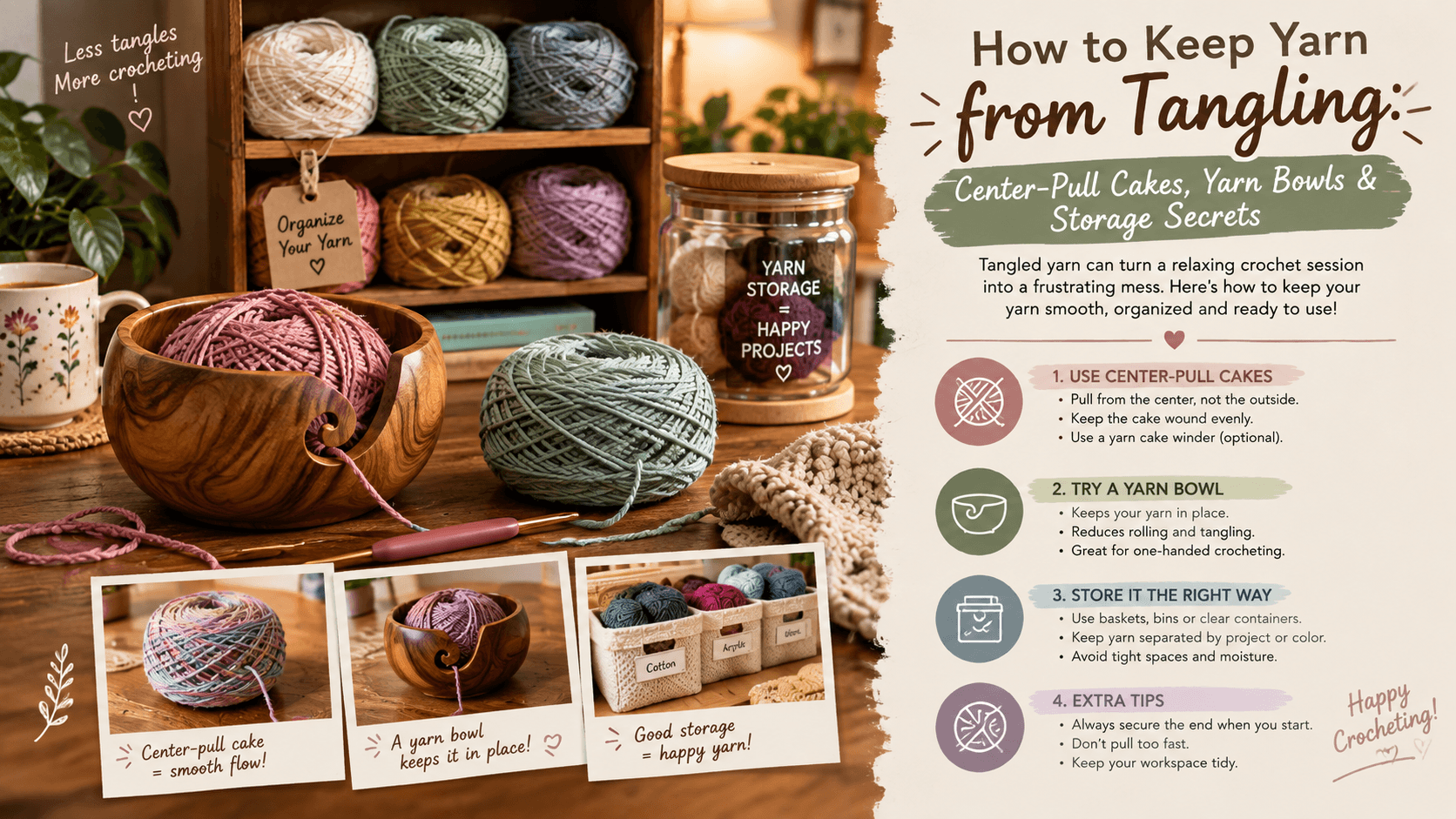
Why Does Yarn Keep Tangling While Crocheting?
Yarn can tangle for several different reasons.
Sometimes the problem starts before you even pick up your crochet hook. A loosely wound skein may collapse as you use it, while an outside-pull ball can roll around your workspace and drag the working strand around chair legs, table corners, or other yarn.
Multiple colors create another problem.
If you have three, four, or even ten strands attached to a project, those strands can twist around each other every time you turn your work.
And sometimes the yarn isn't actually tangled at all.
You've simply pulled a large amount of yarn from the center of a skein.
That's the infamous yarn barf.
The good news is that each problem has a slightly different solution.
1. Choose How Your Yarn Will Feed Before You Start
There are two basic ways to work from a yarn ball or skein:
Center Pull
You pull the working yarn from the inside of the ball.
The yarn ball generally stays in one place while the strand feeds from the center.
Outside Pull
You pull the yarn from the outside of the ball.
The ball may rotate or roll as you work.
Neither method is universally better.
However, many crocheters prefer a center-pull yarn ball because the ball can stay relatively stationary while the yarn feeds from the middle. Lion Brand specifically notes that many people prefer pulling from the center because it can keep the ball neater.
The important word is can.
Center pull doesn't guarantee that your yarn will never tangle.
2. Turn a Messy Skein Into a Center-Pull Yarn Cake
If your yarn doesn't already come in a convenient center-pull format, you can wind it into a center-pull yarn cake.
A yarn cake has a flat top and bottom, so it can sit on a table without constantly rolling away.
You can make one with:
A yarn swift
A yarn ball winder
A nostepinne
Or even by hand
A yarn winder is particularly useful if you regularly buy yarn in hanks or need to organize leftover yarn from previous projects.
Why use a yarn cake?
A center-pull cake can:
Stay in one place
Feed yarn from the center
Fit neatly into project bags
Stack more easily
Make leftover yarn easier to store
Reduce the amount of rolling around your workspace
Hand-winding is also a perfectly reasonable option if you don't want to buy a winder. A neat center-pull cake can be made by hand and is especially useful for small amounts of leftover yarn.
3. Don't Confuse a Center-Pull Cake With a Tangle-Proof Cake
Here's something many crochet tutorials leave out.
A center-pull yarn cake can still create a mess.
As you pull yarn from the middle, the inside of the cake gradually becomes empty.
Eventually, the structure can collapse.
You may suddenly pull out a large loose clump of yarn.
That's yarn barf.
It looks terrible, but it doesn't necessarily mean the entire skein is ruined.
In fact, The Crochet Crowd demonstrates that some commercially wound center-pull balls can produce a large clump from the middle before the yarn starts feeding normally again.
What should you do?
Don't yank on the working strand.
Instead:
Stop crocheting.
Set the project down.
Pull the loose section out gently.
Find the actual working strand.
Separate the loose loops.
Wind the excess loosely around the outside of the ball or set it beside you.
Continue crocheting.
The loose yarn can often be used up as you continue.
4. Use a Yarn Bowl to Stop Your Yarn Ball From Running Away
If your yarn constantly rolls across the floor, a yarn bowl can make a noticeable difference.
A typical yarn bowl is a weighted bowl with a curved or spiral opening.
You place your yarn ball inside and feed the working strand through the opening.
Instead of chasing your yarn around the room, the ball stays contained.
A yarn bowl is especially useful with outside-pull yarn balls.
It can also keep yarn away from dusty floors and reduce the chance of the working strand wrapping around furniture.
Do you need an expensive yarn bowl?
No.
The main purpose is simply to control the movement of the yarn.
A basket, box, or other container can sometimes do the same job.
Even experienced crocheters use simple containers when they're more convenient than a dedicated yarn bowl.
The goal isn't the accessory.
The goal is keeping the yarn in one controlled location.
5. Yarn Bowl vs Center-Pull: Which Is Better?
They're solving slightly different problems.
| Problem | Better Solution |
|---|---|
| Yarn ball keeps rolling away | Yarn bowl |
| You want stationary yarn | Center pull |
| Messy skein needs organizing | Yarn winder |
| Multiple colors keep tangling | Yarn bobbins |
| Yarn collapses while center pulling | Yarn sleeve or container |
| Leftover yarn is messy | Rewind into small cakes |
| Yarn tangles in storage | Separate and organize balls |
And you can combine them.
For example:
Center-pull yarn cake + yarn bowl = very controlled yarn feeding
But again, you don't have to buy both.
6. Keep Multiple Yarn Colors From Becoming One Giant Knot
Colorwork is where yarn management gets serious.
If you're making:
Tapestry crochet
Intarsia crochet
Graphgans
C2C blankets
Striped blankets
Multicolor amigurumi
Pixel crochet
you may have several yarn strands attached to the same project.
If all of those strands are allowed to move freely, they can quickly twist together.
The easiest solution is to give each color its own controlled yarn source.
7. Use Yarn Bobbins for Small Sections of Color
Yarn bobbins are one of the most useful tools for crochet colorwork.
Instead of keeping an entire skein attached to a small color section, wind a manageable amount of yarn onto a bobbin.
This works particularly well when a color appears in a small area and then disappears.
Bobbins can be:
Plastic
Cardboard
Handmade
Clothespins
Small commercial bobbins
The important part is that each color has its own compact supply.
Crochet.com specifically recommends yarn bobbins for managing multiple colors in C2C projects because they help reduce tangling when several strands are attached.
8. Don't Let Every Color Hang From the Same Side
Here's a simple colorwork habit that can save you a surprising amount of frustration:
Keep your yarns in a consistent order.
For example:
Red → Blue → Green → Yellow
Try to maintain that order rather than constantly moving colors over and under one another.
When changing colors, also be consistent about where you drop the unused strand.
A recent crochet colorwork guide recommends consistently dropping colors to the same side and periodically letting attached yarns hang so they can untwist.
You don't need a complicated system.
You just need a predictable one.
9. Let Your Yarn Untwist Before It Becomes a Knot
This is one of the easiest colorwork tricks to overlook.
Suppose you're working with two colors.
Every time you switch between them, the strands may wrap around each other.
Do this repeatedly and eventually you have a miniature yarn rope.
Before that happens, stop.
Hold the project so the attached yarn strands can hang freely.
Let them unwind.
Then continue.
It's much easier to prevent a twist from becoming a knot than to undo a knot after several rows.
10. Give Each Active Yarn Its Own Space
If you're using several skeins at once, don't put all of them into one giant pile beside you.
Give each one its own area.
You can use:
Separate yarn bowls
Small baskets
Project boxes
Individual bags
Yarn bobbins
Divided storage containers
The idea is simple:
One yarn source → one controlled feeding path.
This becomes especially important with crochet blankets and graphgans, where multiple color sections may be active at the same time.
11. How to Untangle Yarn Without Making the Knot Worse
When you discover a knot, your first instinct is probably to pull.
Don't.
Pulling the working end can tighten every loop around the knot.
Instead, spread the tangled yarn out on a flat surface.
Then:
Find the loose outer loops.
Separate them gently with your fingers.
Look for the strand that is actually connected to your working yarn.
Follow that strand through the tangle.
Loosen one loop at a time.
Avoid pulling hard on any section that doesn't move freely.
If the knot is especially complicated, a crochet hook or blunt tapestry needle can help you lift individual loops.
The goal is to make the knot larger before making it smaller.
That sounds backwards, but loosening the surrounding loops gives you room to see how the strands are actually crossing.
12. Don't Pull Your Yarn Directly From the Floor
This sounds obvious, but it causes more problems than you'd think.
When a yarn ball rolls across the floor, the working strand can wrap around:
Chair legs
Table legs
Your feet
Other yarn
Storage boxes
Crochet hooks
Project bags
Eventually you pull on the strand and accidentally tighten one of those loops.
Keep your active yarn near your chair or on a small side table.
The Crochet Crowd recommends keeping yarn balls relatively stationary and at a convenient height while center pulling.
13. Store Yarn So It Doesn't Become Tangled Before You Use It
Yarn management doesn't stop when you finish crocheting.
Poor storage can create a mess before your next project even begins.
For loose yarn balls:
Keep different balls separated
Secure loose ends
Avoid stuffing many balls into one tightly packed bag
Keep yarn away from moisture
Avoid crushing delicate yarn
Store leftovers in labeled bags or containers
For partially used center-pull cakes, you can tuck the working end into the cake or secure it around the outside so it doesn't unwind inside your project bag.
If you have many leftovers, small reusable bags or clear containers make it much easier to identify colors later.
14. What to Do With Leftover Yarn
Don't throw your leftovers into one giant storage bin.
That's how you end up with a knot museum.
Instead, rewind leftover yarn into small balls or cakes.
Then organize them by:
Color → Weight → Fiber
For example:
Green → DK → Cotton
or:
Cream → Worsted → Acrylic
You can also keep the original yarn label with the leftover yarn.
That makes it much easier to find a matching yarn when you need it months later.
15. Use a Yarn Sleeve When Your Cake Keeps Collapsing
If your center-pull ball constantly collapses into itself, a yarn sleeve or yarn bra can help hold the outer structure together.
These stretchy sleeves fit around the yarn ball and provide light compression as the center empties.
They're especially useful when:
You're near the end of a large skein
The outer yarn keeps collapsing inward
The cake is becoming difficult to manage
You want to keep loose yarn contained
But you don't necessarily need to buy one.
A suitable reusable yarn holder or project container can sometimes provide enough structure.
The Best Setup for Tangle-Free Crochet
If you want a simple setup rather than a pile of gadgets, try this:
For one-color projects
Center-pull cake + small basket
That's enough for many projects.
For a rolling yarn ball
Yarn ball + yarn bowl
The bowl keeps the yarn contained.
For multiple colors
Small cakes or skeins + yarn bobbins
Give each color its own feeding point.
For large colorwork
Bobbins + organized yarn tray
Keep the active colors in a consistent order.
For messy leftovers
Small center-pull cakes + labeled storage bags
Simple organization now saves a lot of untangling later.
What Is “Yarn Barf”?
If you've never heard the expression before, yarn barf is the informal crochet and knitting term for the large tangled-looking clump of yarn that sometimes comes out of the center of a skein when you try to find the center pull.
It doesn't necessarily mean something went wrong.
Some commercially wound skeins simply have extra yarn tucked around the center.
If it happens, gently pull out the loose section until you locate the actual working strand, then separate the excess instead of pulling aggressively. Lion Brand provides a similar process for finding the center pull in its skeins.
Once you know how to deal with it, yarn barf becomes more of an annoyance than a disaster.
How to Keep Yarn From Tangling in a Crochet Bag
Project bags are convenient—but they can turn into a tangle trap.
Before putting your project away:
Secure the live loop.
Then:
Stop the working yarn from freely unraveling.
Place the yarn ball or cake next to the project.
Keep loose strands contained.
Avoid stuffing multiple active yarn colors into one compartment.
Close the bag without crushing the yarn.
For colorwork projects, individual bags or compartments for active colors can make a huge difference.
A Simple 30-Second Yarn Management Routine
Before you start crocheting, ask yourself:
Where is my yarn coming from?
Center pull or outside pull?
Can the ball roll away?
If yes, put it in a bowl, basket, or container.
Am I using multiple colors?
Give each color its own space.
Are my strands twisting?
Stop and untwist them before the twist becomes a knot.
Am I finished for today?
Secure the live loop and contain the working yarn.
This tiny routine can prevent a surprising amount of frustration.
Quick Answers About Yarn Tangling
Is center-pull yarn better for crochet?
It can be very convenient because the ball can stay relatively stationary while the yarn feeds from the center. However, center-pull yarn can still produce tangles or a “yarn barf” clump depending on how the ball was wound.
Do yarn bowls actually work?
Yes, they can help control a rolling yarn ball and keep the working strand feeding from a fixed location. But a yarn bowl won't untangle yarn that is already knotted.
What is the best way to stop yarn tangling in colorwork?
Use separate yarn sources or bobbins for smaller color sections, keep the colors in a consistent order, and periodically untwist the strands.
Should I pull yarn from the center or outside?
Either can work. Center pull keeps the ball more stationary, while outside pull can be simpler for some skeins. Choose whichever gives you the smoothest feed with your particular yarn.
How do I stop my yarn ball from rolling?
Put it in a yarn bowl, basket, box, or another container that keeps it from moving around.
How do I untangle yarn without making it worse?
Stop pulling, spread the tangle out, loosen the outer loops, and follow individual strands through the knot rather than tightening them.
The Secret to Tangle-Free Crochet Isn't More Gadgets
You don't need a $100 yarn-management station to keep your crochet yarn under control.
For most projects, three habits make the biggest difference:
Keep the yarn contained.
Keep multiple colors separated.
Untwist strands before they become knots.
A center-pull cake can be convenient. A yarn bowl can stop your yarn from rolling away. Bobbins can make colorwork dramatically easier.
But the real goal behind all three is the same:
Control where your yarn comes from and where it goes.
Once your yarn has a predictable path, you can spend less time fighting knots and more time actually crocheting.
Keep Your Crochet Flowing
A good crochet project should feel relaxing—not like you're solving a new puzzle every five minutes.
At AlbaCrochet, you'll find beginner-friendly crochet patterns and practical guides covering everything from yarn selection and hook sizes to color changes, finishing techniques, and project care.
Organize your yarn, grab your hook, and get back to the part that actually matters: making something beautiful.
Next Steps
Continue Learning
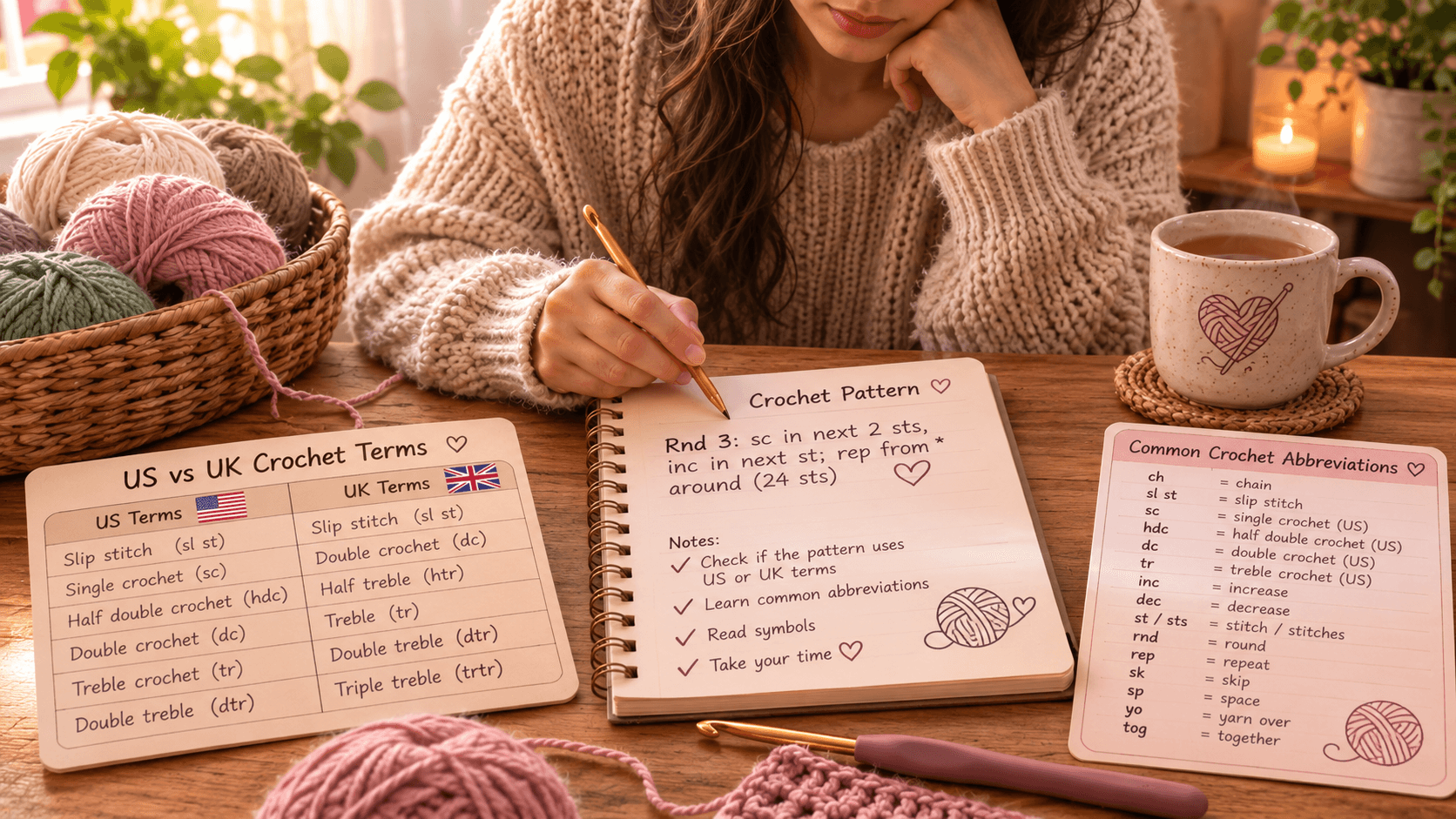
How to Read Crochet Abbreviations: US vs UK Terms and Pattern Symbols
The first time you open a crochet pattern, it can feel like you're reading another language. You might see something like this: *Rnd 3: sc in next 2 sts, inc in next st; rep from * around (24 sts) If you're a beginner, that single line can look more confusing than the actual crocheting. The good news is that crochet abbreviations are simply shorthand. Once you understand the most common terms, symbols, and repeat instructions, patterns become much easier to follow. The most important thing to learn first is that crochet terminology can change depending on where the pattern was written. A US double crochet (dc) is not the same stitch as a UK double crochet (dc). Using the wrong terminology can completely change the size and appearance of your project. This guide explains how to read crochet abbreviations, understand US and UK terms, decode pattern symbols, and break down complicated-looking instructions step by step.
Read tutorial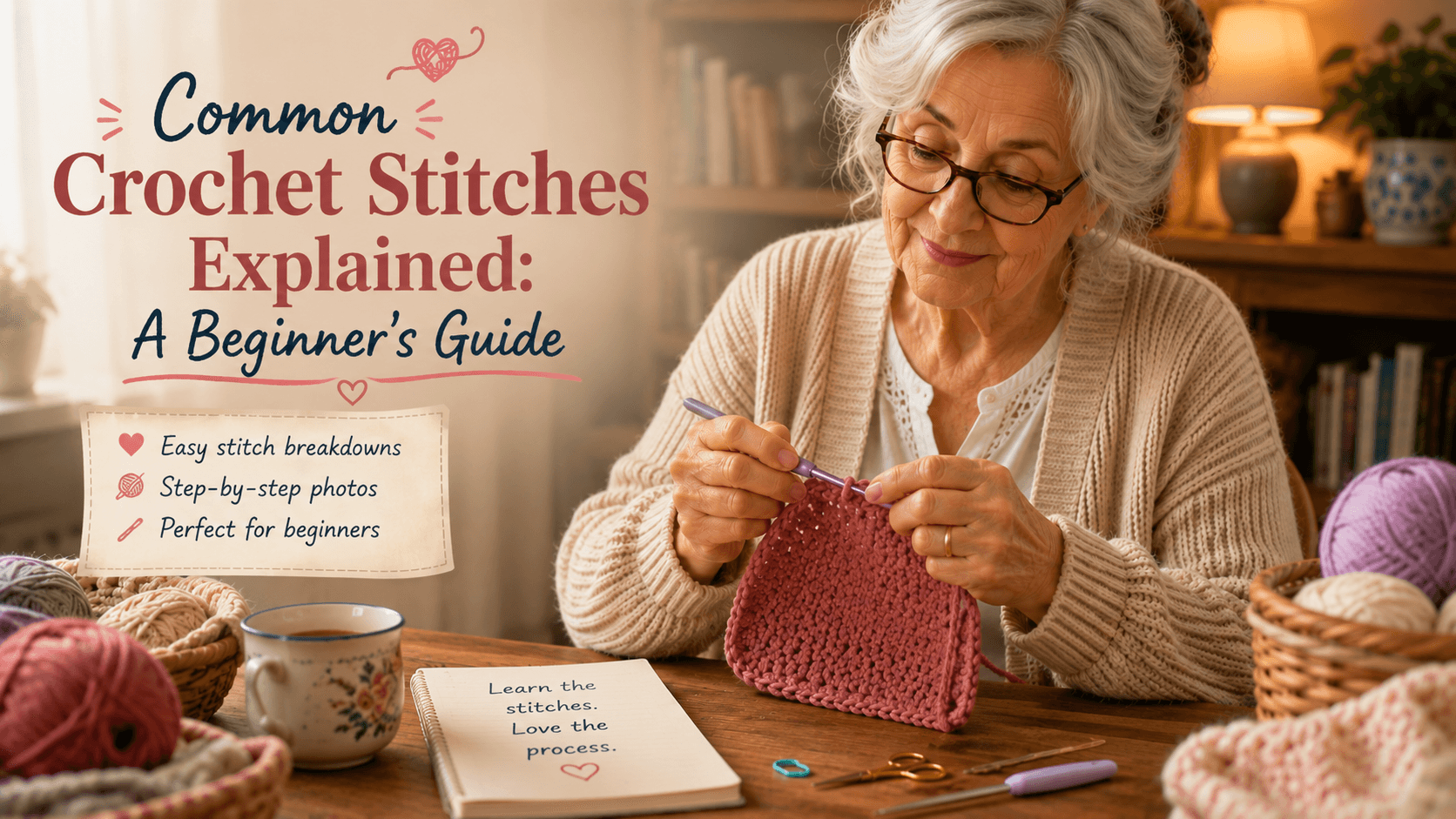
Common Crochet Stitches Explained
Learning a handful of basic crochet stitches is enough to unlock hundreds of patterns. You don't need to memorize dozens of complicated techniques before you can start making something useful. Once you understand how to work the basic stitches, read their abbreviations, and recognize how they change the look of your fabric, patterns become much easier to follow. This guide covers the most common crochet stitches for beginners, including single crochet, half double crochet, double crochet, treble crochet, and slip stitch. You'll also see what each stitch looks like, how to work it, and when it's most useful.
Read tutorial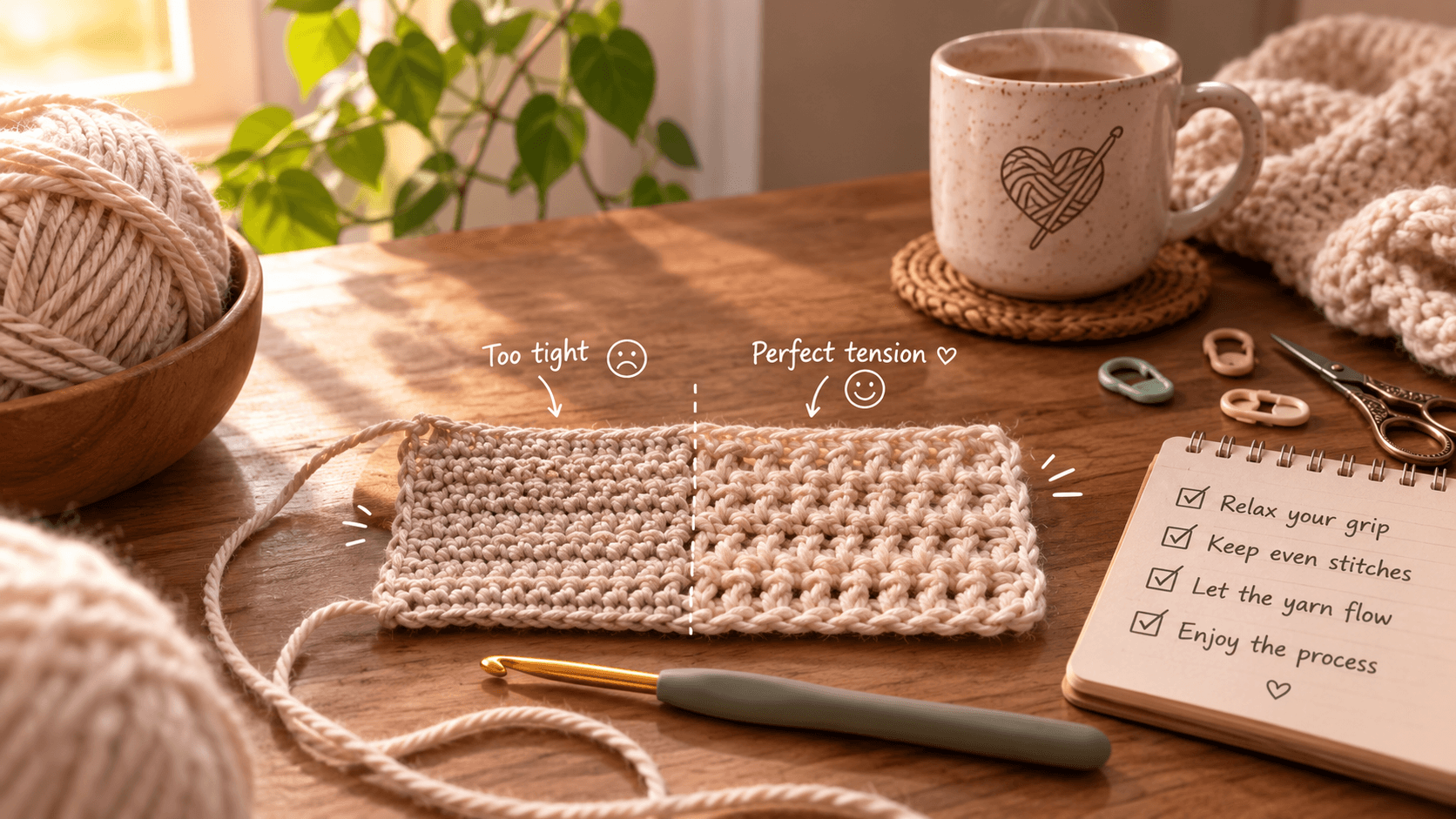
Why Is My Crochet Getting Tighter? 5 Causes and Easy Fixes
If your crochet is getting tighter as you go, you're not alone. You may notice that your stitches are getting smaller, your project is becoming narrower, your fabric feels stiff, or your crochet hook is becoming difficult to insert into each stitch. In most cases, tight crochet stitches are caused by changing yarn tension, gripping the hook or yarn too tightly, pulling loops too tight, using the wrong hook size, or accidentally skipping stitches. The good news is that you usually don't need to start over. Once you identify why your crochet tension is too tight, you can make a few small adjustments to create smoother, more even stitches.
Read tutorialReady to make something?
Put your new skills to use with our free pattern collection.