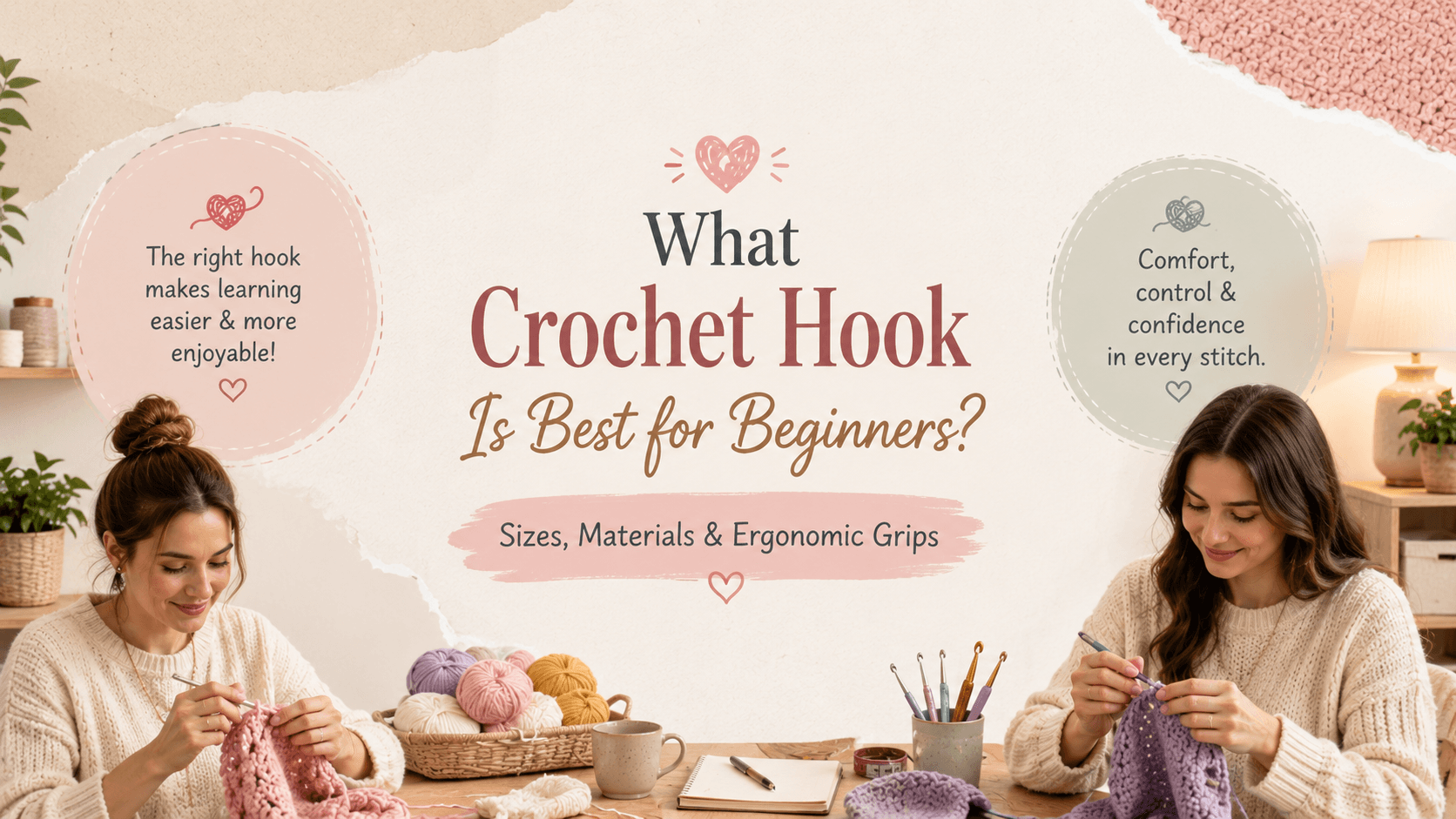
What Crochet Hook Is Best for Beginners? Sizes, Materials & Ergonomic Grips
If you’re learning how to crochet, choosing your first hook can feel surprisingly confusing. There are aluminum hooks, plastic hooks, bamboo hooks, ergonomic crochet hooks, inline hooks, tapered hooks—and then there are all those numbers: 3.5 mm, 4 mm, 5 mm, 5.5 mm, 6 mm… So what is actually the best crochet hook for beginners? For most people, a 5 mm or 5.5 mm crochet hook paired with medium-weight yarn is an excellent place to start. These sizes are large enough to make your stitches easy to see without being awkward to control. A smooth metal hook is also a practical choice, while an ergonomic handle can make longer practice sessions more comfortable. But there isn't one perfect crochet hook for everyone. Your yarn, hand position, tension, and personal comfort all matter. Here's how to choose a beginner crochet hook without buying an entire collection before you've even learned your first stitch.
The Best Crochet Hook Size for Beginners
If you want the simple answer, start with:
5.0 mm (H-8) or 5.5 mm (I-9)
These are two of the most useful crochet hook sizes for beginners, particularly when learning with medium or worsted-weight yarn.
According to the Craft Yarn Council, a 5 mm hook corresponds to US H-8 and a 5.5 mm hook corresponds to US I-9. The organization recommends paying attention to the metric millimeter measurement because letter and number systems can vary between manufacturers.
| Crochet Hook Size | US Size | Good Starting Use |
|---|---|---|
| 4.0 mm | G-6 | Smaller medium-weight projects |
| 4.5 mm | 7 | Medium-weight yarn |
| 5.0 mm | H-8 | Excellent beginner starting point |
| 5.5 mm | I-9 | Beginner practice, scarves, blankets |
| 6.0 mm | J-10 | Looser fabric and thicker yarn |
| 6.5 mm | K-10½ | Chunkier projects |
The important part is that hook size should match your yarn and project.
A 5 mm hook isn't automatically the right choice just because you're new to crochet.
If your beginner crochet pattern recommends a 4 mm hook, use the recommended size. If you're working with bulky yarn, you'll probably need something much larger.
Why 5 mm and 5.5 mm Crochet Hooks Are So Popular
Medium-sized hooks give beginners a useful balance.
With a very small hook, the stitches can become tiny and difficult to see. This can make it harder to identify where to insert your hook when you're still learning single crochet, half double crochet, and double crochet.
On the other hand, a very large hook creates bigger loops and a looser fabric. That can make your stitches easier to see, but the fabric may feel floppy and the hook can become harder to control.
A 5 mm crochet hook sits comfortably in the middle for many beginner projects.
A 5.5 mm crochet hook gives you slightly more room to work and may feel better if your tension is naturally tight.
If you're deciding between the two, don't overthink it:
Use the hook recommended by your pattern. If you're simply practicing with medium-weight yarn, try 5 mm first and move to 5.5 mm if your stitches feel cramped.
What Is the Best Yarn to Learn Crochet With?
Your first crochet hook choice makes more sense once you've chosen your yarn.
For many beginners, medium-weight yarn (Category 4) is a convenient starting point because the stitches are large enough to see clearly without requiring a huge hook.
Look for yarn with:
A smooth surface
Clear stitch definition
Medium thickness
Minimal fuzz
A color that makes your stitches easy to see
Very dark yarn can make learning more difficult because the individual loops are harder to distinguish.
Likewise, fuzzy yarn, chenille, and very thin yarn can be frustrating when you're still trying to understand where your hook belongs.
A smooth acrylic or cotton yarn can be a much easier first practice yarn.
Aluminum vs Plastic vs Wood: Which Crochet Hook Material Is Best?
Crochet hooks are made from several materials, including aluminum, steel, plastic, bamboo, and wood.
Each material feels different.
Aluminum Crochet Hooks
Aluminum hooks are one of the easiest choices for beginners.
They're lightweight, durable, and generally have a smooth surface that allows yarn to move easily.
A basic aluminum crochet hook is also inexpensive, so you don't have to spend much money while you're learning.
Best for:
Beginners, everyday crochet, smooth yarn, and learning basic stitches.
Plastic Crochet Hooks
Plastic hooks are lightweight and inexpensive.
They're especially common in beginner crochet kits, although the quality can vary. A well-made plastic hook can work perfectly well, while a poorly finished hook may have rough edges that interfere with your yarn.
Best for:
Budget beginners, larger hook sizes, and occasional crochet.
Bamboo and Wooden Crochet Hooks
Wood and bamboo hooks have a different feel from metal.
They can provide slightly more grip on slippery yarn, which some crocheters appreciate. The trade-off is that they may not feel as fast or smooth as a polished metal hook.
Best for:
Crocheters who prefer a warmer, grippier feel.
Steel Crochet Hooks
Steel hooks are generally associated with very small sizes and fine crochet work.
They're not usually what you need for learning basic stitches with medium-weight yarn.
Best for:
Thread crochet and very fine yarn.
Are Ergonomic Crochet Hooks Better for Beginners?
They can be—but they're not mandatory.
An ergonomic crochet hook usually has a thicker or shaped handle designed to make the tool easier to hold.
Instead of gripping a narrow metal shaft with your fingertips, your hand gets a larger surface to hold.
This can be particularly useful if a standard crochet hook feels uncomfortable during longer sessions.
However, an ergonomic handle isn't a magic solution for hand pain. Comfort varies from person to person, and even an ergonomic hook can feel wrong if the handle is too large, too soft, too heavy, or poorly balanced.
So rather than asking:
“Are ergonomic crochet hooks better?”
A better question is:
“Does this hook allow me to hold the tool comfortably without squeezing it too tightly?”
That's what matters.
Best Crochet Hook for Hand Comfort
If you're experiencing crochet hand fatigue, pay attention to the handle rather than simply buying the most expensive hook.
Try to find a handle that:
Doesn't force your fingers into a tight pinch
Feels secure without squeezing
Fits comfortably between your thumb and fingers
Doesn't feel excessively heavy
Allows your wrist to remain relatively relaxed
A wider handle can be more comfortable for some crocheters because it gives the fingers more surface area to hold.
But don't assume that the thickest handle is automatically the most ergonomic.
Your hand size and crochet grip matter.
Pencil Grip vs Knife Grip: Which Crochet Hook Handle Is Better?
You may hear crocheters talk about pencil grip and knife grip.
The names simply describe different ways of holding the hook.
With a pencil grip, you hold the hook more like a pencil, generally using your thumb and index finger to control it.
With a knife grip, your hand sits more over the hook, similar to holding a knife.
Neither grip is inherently the “correct” crochet grip.
If you're a beginner, don't force yourself into a particular grip just because another crocheter recommends it.
Instead, concentrate on three things:
Can you control the hook?
Can you form stitches consistently?
Does your hand stay reasonably comfortable?
If the answer is yes, your grip is probably working for you.
Inline vs Tapered Crochet Hooks
Another decision beginners often encounter is inline vs tapered crochet hooks.
This refers to the shape of the hook head and throat.
Inline Crochet Hooks
An inline hook has a more clearly defined head and a shaft that stays aligned with the hook.
Some crocheters like inline hooks because the deeper, more defined hook can give them a stronger sense of control over the loop.
Tapered Crochet Hooks
A tapered hook gradually narrows toward the hook head.
Many crocheters find this shape smooth and easy to move through stitches.
Neither design is universally better. Current crochet guides and manufacturers generally present inline and tapered hooks as different preferences rather than one being objectively superior.
If you're buying your first hook, don't let inline vs tapered stop you from starting.
Pick a comfortable, well-finished hook and learn the basics first.
Your preference will become much clearer after you've crocheted a few projects.
What Crochet Hook Should a Complete Beginner Buy?
If you're standing in a craft store right now and have no idea what to buy, here's the simple setup I'd recommend:
Option 1: The Basic Starter
5 mm aluminum crochet hook + medium-weight yarn
This is inexpensive and gives you everything you need to practice chains, single crochet, half double crochet, double crochet, increases, decreases, and basic rows.
Option 2: The Comfort Starter
5 mm ergonomic crochet hook + medium-weight yarn
Choose this if you already know that narrow handles feel uncomfortable in your hand or you expect to practice for longer sessions.
Option 3: The Two-Hook Starter
Buy both:
5 mm
5.5 mm
This gives you a little flexibility without buying a giant crochet hook set.
Once you start following patterns, you'll naturally accumulate other sizes.
Don't Buy a 20-Piece Crochet Hook Set Yet
A huge crochet hook set looks tempting when you're starting.
But you don't need 20 different sizes to learn how to crochet.
Your first goal isn't to own every crochet hook.
It's to become comfortable making stitches.
Start with one or two useful sizes. Once you begin making scarves, blankets, hats, amigurumi, garments, or other projects, you'll discover which crochet hook sizes you actually use.
That's when buying a larger set starts making more sense.
What About Amigurumi?
If your goal is specifically to learn amigurumi, don't automatically start with a 5 mm hook.
Amigurumi is usually worked with a smaller hook relative to the yarn so the finished fabric is dense and doesn't have large gaps.
A beginner making crochet animals may therefore end up using something around 2.5–4 mm depending on the yarn, pattern, and desired fabric.
This is one reason there isn't a single best crochet hook for beginners.
The best hook depends on what you're planning to make.
For general crochet practice: 5–5.5 mm is a useful starting range.
For amigurumi: expect to use a smaller hook.
For chunky blankets: you'll probably need a larger hook.
For crochet thread: you'll need a much smaller hook.
How Do You Know If Your Crochet Hook Is the Wrong Size?
Your stitches can give you clues.
Your stitches are extremely tight
You may be using too small a hook, holding your yarn too tightly, or both.
Try relaxing your grip first. If the fabric is still too dense, test a larger hook.
Your stitches are extremely loose
Try a smaller hook or slightly relax the amount of yarn you pull through each stitch.
Your fabric feels stiff
A smaller hook and tight tension can create a dense fabric.
If the pattern allows it, try a larger hook.
Your fabric has large gaps
You may be using a hook that's too large for the yarn, or your tension may simply be loose.
Your hand hurts while crocheting
Stop and reassess your grip.
You may be squeezing the hook too tightly or working with a handle that doesn't suit your hand. An ergonomic crochet hook may help with comfort, but persistent or significant hand pain shouldn't be ignored.
The Best Beginner Crochet Hook Is the One You Can Control
There's a lot of pressure online to find the “perfect” crochet hook.
You don't need one.
If you want the safest starting point, choose a 5 mm or 5.5 mm crochet hook, pair it with smooth medium-weight yarn, and start practicing.
From there, pay attention to how the hook feels.
Maybe you'll love a traditional aluminum hook.
Maybe you'll prefer an ergonomic handle.
Maybe an inline hook gives you the control you want.
Or maybe a tapered crochet hook feels much smoother.
That's part of learning crochet.
Your first hook isn't supposed to be your forever hook. It's simply the tool that helps you learn how your hands, yarn, tension, and stitches work together.
Beginner Crochet Hook Cheat Sheet
Best all-around starting size: 5 mm
Alternative: 5.5 mm
Best beginner yarn: Smooth medium-weight yarn
Best beginner material: Aluminum is a practical starting choice
Best for comfort: An ergonomic handle if it feels better in your hand
Best grip: Pencil or knife—whichever feels natural
Inline vs tapered: Personal preference
For amigurumi: Usually a smaller hook than general crochet
Most important rule: Follow the hook size recommended by your pattern when one is provided.
And remember: the number printed on the hook is only part of the equation. Your yarn, tension, project, and desired fabric all influence the final result. For projects with a specified gauge, make a gauge swatch and adjust your hook size if necessary.
Ready to Make Your First Project?
Once you've got your hook and yarn, the fastest way to improve is to start making something—not spend another week comparing hook sets.
At AlbaCrochet, you'll find beginner-friendly crochet patterns and guides designed to make that first step easier, with clear instructions and practical help when you get stuck.
Pick a project you genuinely want to make, grab your 5 mm hook, and start stitching.
Next Steps
Continue Learning
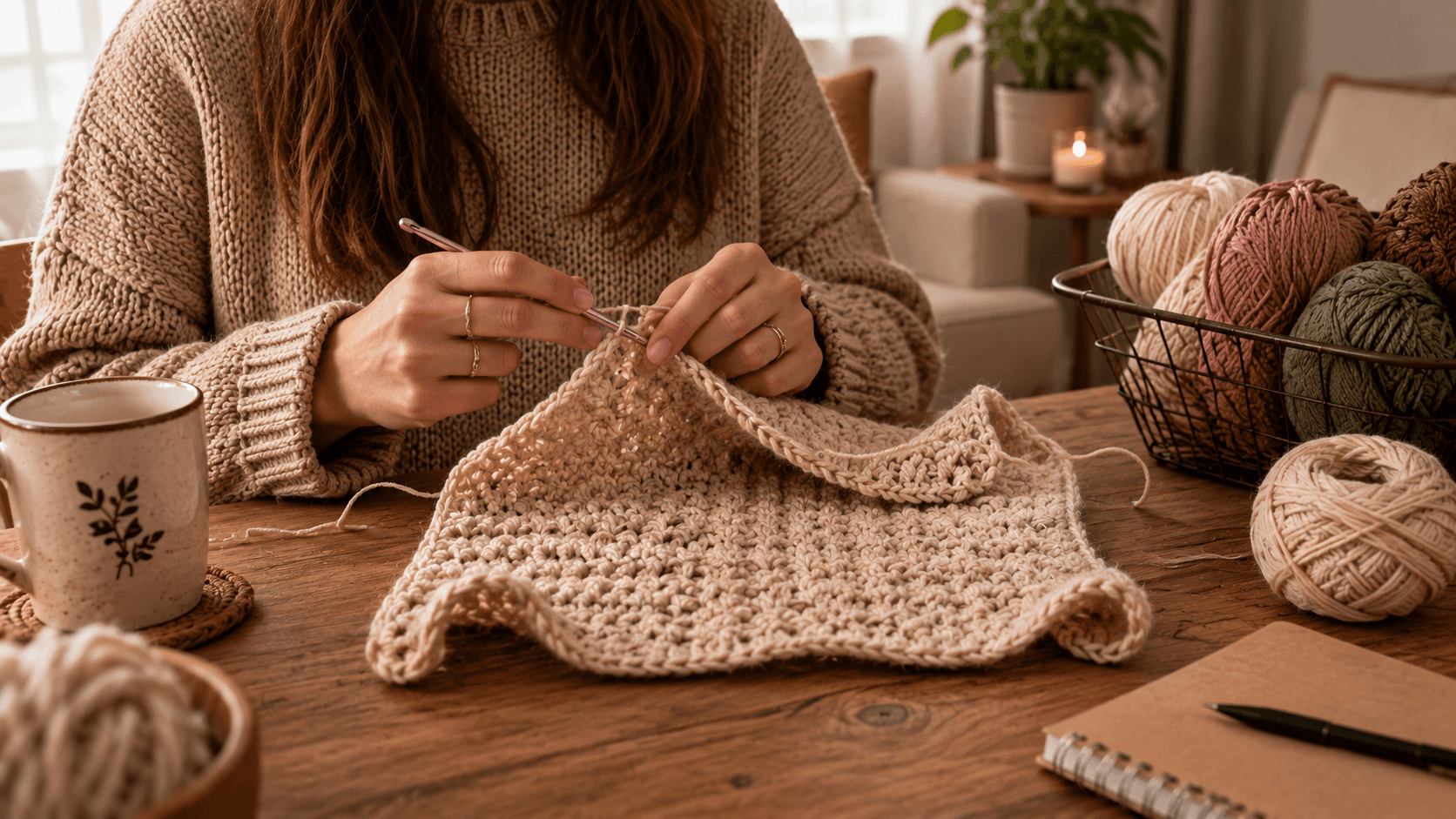
How to Stop Crochet Edges from Curling: Causes and Easy Fixes
If your crochet edges are curling, rolling inward, or refusing to lay flat, you're not alone. Curling is a common crochet problem, especially when working blankets, scarves, shawls, garments, and flat panels. Sometimes the curl starts immediately after the first few rows. Other times, the project looks fine until several rows later. The good news is that you can usually identify the cause and fix it. A crochet project can curl because of a tight foundation chain, uneven tension, stitch imbalance, a dense stitch pattern, or the natural behavior of the yarn and fabric. In this guide, you'll learn how to stop crochet edges from curling, how to fix an existing project, and how to prevent the problem next time.
Read tutorial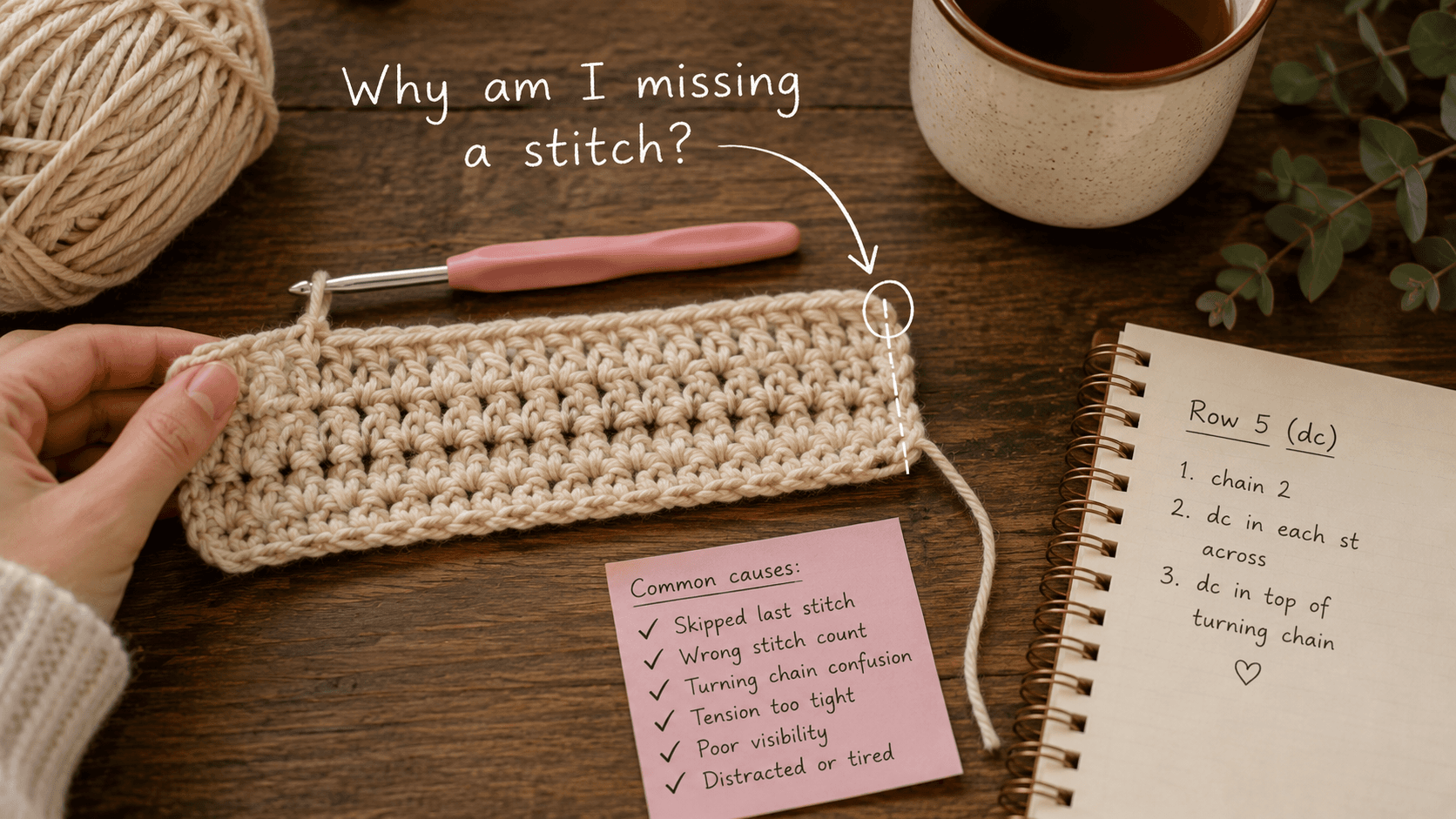
Why Am I Missing a Stitch at the End of My Crochet Row? 6 Common Causes
You finish a few rows, lay your crochet project flat, and suddenly notice something is wrong. Your rectangle is no longer a rectangle. The sides are slowly leaning inward. Your stitch count is getting smaller. And somehow, you're missing a stitch even though you could swear you followed the same steps on every row. This is one of the most common crochet problems, especially when you're working flat in rows. The good news is that your yarn probably isn't shrinking and your hook isn't the problem. In most cases, you're accidentally skipping one of the first or last stitches of the row. The tricky part is that edge stitches can be surprisingly easy to miss. Turning chains can look like stitches, actual stitches can hide beside the turning chain, and tight tension can make the final stitch difficult to see. Let's figure out exactly where your missing crochet stitch is going.
Read tutorial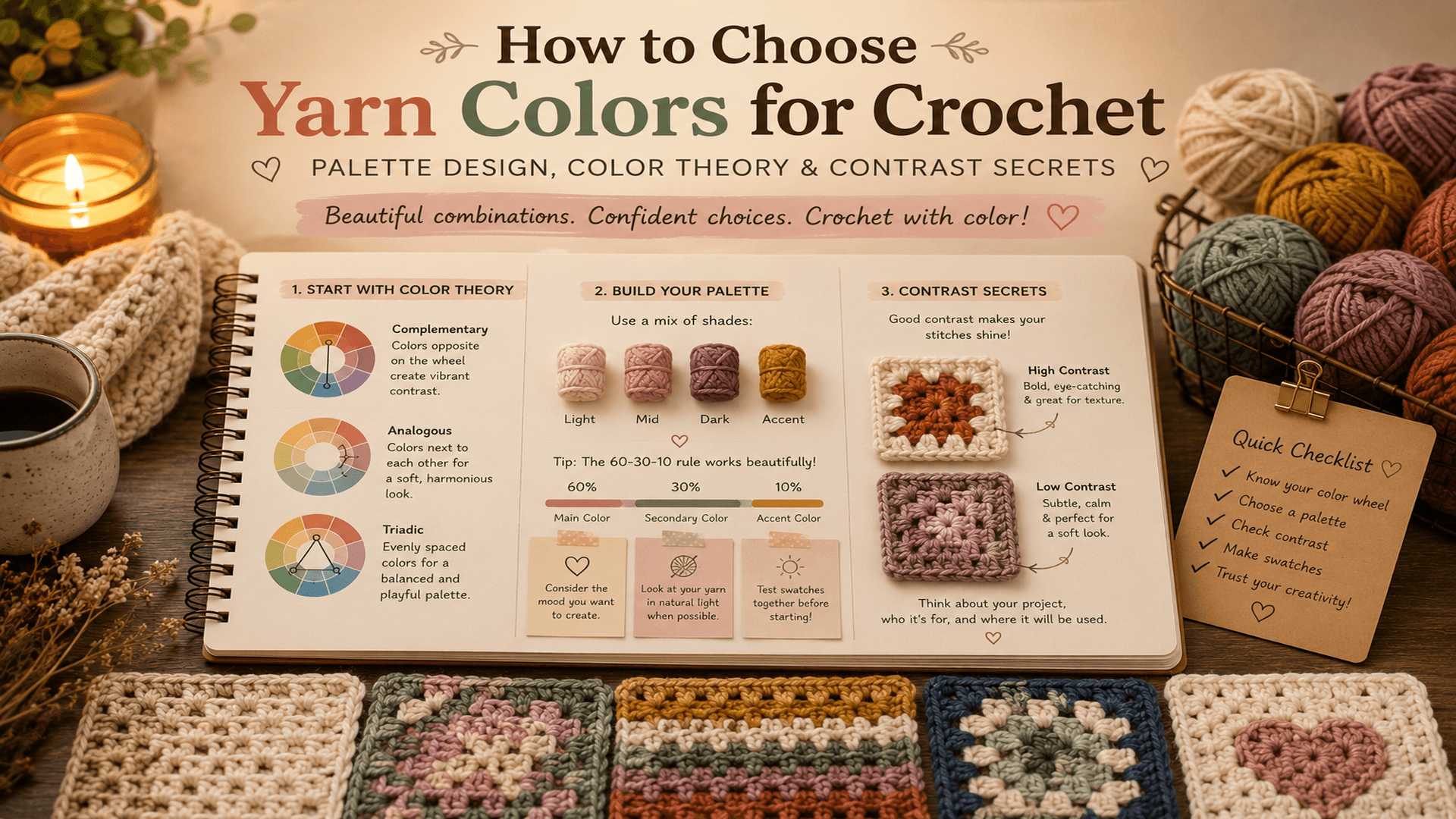
How to Choose Yarn Colors for Crochet: Color Theory, Palettes & Contrast Tips
You find the perfect crochet pattern. The stitches are beautiful. You already know which yarn you want to use. Then you reach the yarn shelf and suddenly have ten different shades in front of you. Cream or white? Sage or olive? Dusty rose or terracotta? And somehow, colors that looked gorgeous on their own don't look nearly as good when you put them together. Choosing yarn colors for crochet can be surprisingly difficult. But you don't need to be an artist or memorize complicated color theory to create a beautiful crochet color palette. A few simple tricks can make a huge difference. You can use the color wheel to find combinations that naturally work together, use contrast to make patterns easier to see, and use a few simple rules to stop your project from looking too busy. Whether you're choosing colors for a crochet blanket, granny squares, a sweater, scarf, bag, or another accessory, this guide will help you put together a yarn color palette that looks intentional and balanced.
Read tutorialReady to make something?
Put your new skills to use with our free pattern collection.